Desire to Have No Desire

Table of Content: I’m Not Right but That’s OK

Having no desire (无欲) is the fundamental principle to achieving Enlightenment. Having desire (有欲) is useful, but not necessarily good or bad (无为本 有为用). If I desire to have no desire (我欲无欲), that means I still have desire. The use is I can slowly forget myself (忘我); then I will have no body (无身), therefore no emotion, and finally achieve the abandonment of desire (绝对无欲). For that to happen, I must forget about my initial desire to have no desire (i.e. don’t keep thinking about achieving something); finally, even the “desire to have no desire” is abandoned. When we reach our destination, we don’t need any more muscle energy to move further; when we reach the state of no desire, we don’t need any more desire. But in order to live, I need to eat and exercise (虚其心 实其腹 弱其志 强其骨); therefore I can only minimize my desire (寡欲). Totally no desire means I will forget to live; all the fires in my body will be extinguished and reaching the state of parinirvana (涅磐). I am not sure whether that is good or bad; after all, nothing is good or bad. Having no desire is to leave this world (出世), or rise above the worldly world (超越世俗). Having desire is to stay in this world (入世); extinguishing the fires of greed, hatred and delusion is still possible and helpful for one’s happiness.
you only lose what you cling to

I have heard that on one occasion Ven. Ananda was staying in Kosambi, at Ghosita’s Park. Then the Brahman Unnabha went to where Ven. Ananda was staying and on arrival greeted him courteously. After an exchange of friendly greetings & courtesies, he sat to one side. As he was sitting there, he said to Ven. Ananda: “Master Ananda, what is the aim of this holy life lived under Gotama the contemplative?”

“Brahman, the holy life is lived under the Blessed One with the aim of abandoning desire.”

“Is there a path, is there a practice, for the abandoning of that desire?”

“Yes, there is a path, there is a practice, for the abandoning of that desire.”

“What is the path, the practice, for the abandoning of that desire?”

“Brahman, there is the case where a monk develops the base of power endowed with concentration founded on desire & the fabrications of exertion. He develops the base of power endowed with concentration founded on persistence… concentration founded on intent… concentration founded on discrimination & the fabrications of exertion. This, Brahman, is the path, this is the practice for the abandoning of that desire.”

“If that’s so, Master Ananda, then it’s an endless path, and not one with an end, for it’s impossible that one could abandon desire by means of desire.”

“In that case, brahman, let me question you on this matter. Answer as you see fit. What do you think: Didn’t you first have desire, thinking, ‘I’ll go to the park,’ and then when you reached the park, wasn’t that particular desire allayed?”

“Yes, sir.”

“Didn’t you first have persistence, thinking, ‘I’ll go to the park,’ and then when you reached the park, wasn’t that particular persistence allayed?”

“Yes, sir.”

“Didn’t you first have the intent, thinking, ‘I’ll go to the park,’ and then when you reached the park, wasn’t that particular intent allayed?”

“Yes, sir.”

“Didn’t you first have [an act of] discrimination, thinking, ‘I’ll go to the park,’ and then when you reached the park, wasn’t that particular act of discrimination allayed?”

“Yes, sir.”

“So it is with an arahant whose mental effluents are ended, who has reached fulfillment, done the task, laid down the burden, attained the true goal, totally destroyed the fetter of becoming, and who is released through right gnosis. Whatever desire he first had for the attainment of arahantship, on attaining arahantship that particular desire is allayed. Whatever persistence he first had for the attainment of arahantship, on attaining arahantship that particular persistence is allayed. Whatever intent he first had for the attainment of arahantship, on attaining arahantship that particular intent is allayed. Whatever discrimination he first had for the attainment of arahantship, on attaining arahantship that particular discrimination is allayed. So what do you think, brahman? Is this an endless path, or one with an end?”

“You’re right, Master Ananda. This is a path with an end, and not an endless one. Magnificent, Master Ananda! Magnificent! Just as if he were to place upright what was overturned, to reveal what was hidden, to show the way to one who was lost, or to carry a lamp into the dark so that those with eyes could see forms, in the same way has Master Ananda — through many lines of reasoning — made the Dhamma clear. I go to Master Gotama for refuge, to the Dhamma, and to the Sangha of monks. May Master Ananda remember me as a lay follower who has gone for refuge, from this day forward, for life.”
Good Buddhist

Table of Content:HOW TO RAISE A RESILIENT KID: I AM NOT RIGHT BUT THAT’S OK

A good Buddhist is first and foremost a happy soul. You must feel happy first before you can possibly make someone else happy. Only then, you will have the energy to wish, every minute of the day, that everybody is happy every minute of the day; like what I am doing now: I just want you to be happy, and the thinking of any form of return or reciprocation never occur to me — Dana or unconditional love (不住相布施,其福德不可思量). Don’t think about benefit when you are giving; this is how to gain the greatest benefit. (Of course, if you are talking about doing business, you have to think about your bottom-line.)

The health of the society and the world is not your responsibility. Never feel sad for whatever happens in the society and the world. If you are happy, you are reducing one suffering soul in the world. That itself is a great contribution to the society and the world. There will be no tree to bear fruit if a seed was never planted in the Earth; there will be no tree if there was no rain and other essential elements for the shoot to grow. Similarly, everything happens due to a multitude of reasons. You didn’t make it happens; it wasn’t your fault, and it wasn’t your credit either. Of course, do what you can to help the poor shoot to grow (众善奉行名为慧); this is one good wisdom. A better wisdom is to have no delusion(心地无痴自性慧); don’t be deluded to think that you can change the world single-handedly. It is also arrogant to think that you must be the one, and not someone else, to effect any change in the society and the world.

You don’t really need much material to feel happy. If you realize that you already have abundance, you can immediately feel happy at this instant. You can live selflessly. Selflessness is the greatest selfishness, because you don’t need to rely on anything to gain your happiness. Furthermore, you are happy to be in a position to give, rather than take. The common people tend to feel happy only when they receive something, in cash or in kind; commonsense is not always right. That is why they are common; good things are rare, but common things are not necessarily bad. An enlightened person knows that the opposite is equally true; giving can be more satisfying than taking. The common people need to always remind themselves not to commit Akusala Karma (诸恶莫作名为戒). If you never think about gaining any benefit, for yourself or your love ones, how would any malevolent motive arises in your heart (心地无非自性戒)? An enlightened person will naturally never do anything wrong due to the lack of motive; he does not need to remind himself of any precept and yet do no wrong.

Not thinking about benefit does not necessarily mean you will not receive any benefit. Receiving benefit is not necessarily bad; giving is also not necessarily good. Giving the wrong things, or giving good things to the wrong people, can be unhelpful. However, you should never worry about the future, or anticipate troubles. Remind yourself to stay calm no matter what happens (自净其意名为定). Better still, learn to see reality as it is and not what you wish it to be (心地无乱自性定), and you will never need to sit down or close your eyes in order to stay calm.

Leadership by example is the best. If you are happy, and you always wish everybody is as happy as you are, you will inspire everybody around you. That is the best Buddhist you can be.

Everything is Perfectly Imperfect

Table of Content:HOW TO RAISE A RESILIENT KID: I AM NOT RIGHT BUT THAT’S OK

If you are not a Buddhist, you should not DESIRE (欲) to assess the quality of any Buddhist group. If you want to become a spiritually awaken Buddhist (见性成佛), you must not DESIRE to assess the quality of any religious group. DESIRE to assess the quality of other persons is extremely egoistic. Ego (妄念) will lead you further from the shore of the island of perpetual blissfulness (彼岸) and into the infinitely bitter sea (无边苦海). The fire of greed, hatred, and delusion (贪嗔痴) will not be extinguished (熄灭), therefore you will not be able to attain Nirvana (寂灭).

Zeal to distinguish who is right and who is wrong had given rise to countless bloodshed and genocide in the history of mankind. One religious group thinks that a different religious group is wrong. Instead of looking at the similarity and common grounds, people choose to focus on the differences. Ego makes them desire to compete in order to become the leader of public opinions. The greed is so obviously exhibited but the followers are blindfolded to the fire of greed in their hearts. They start to view other religious groups as a threat, even though everyone simply ignores them and carry on his daily life with his own way of life. Nobody is publicly competing or challenging their self-proclaimed “authority”; the mere existence of other religious groups is intolerable and seen as a threat to them. While they keep trumpeting how good their religious group is, how many people are converting in favor of them, how profound their religion of peace is, they keep attacking other religious groups, verbally and also physically. They broadcast speeches and videos to criticize and even demonize other religious groups. The hatred is so obviously exhibited but the followers are blindfolded to the fire of hatred in their hearts. Because they desire so much for people to convert in favor of them, they view it as extremely precious thing which they must hold on to; the attachment make them feel infinitely fearful of losing followers to other religious groups. They make death threat to those attempting to leave, yet they continue to trumpet their religion as a religion of peace. The delusion is so obviously exhibited but the followers are blindfolded to the fire of delusion in their hearts. It is a delusion because the actions are completely opposite to the peace of mind which they treasure so much. Actions speak louder than words.

善知识,自性能含万法是大,万法在诸人性中。若见一切人恶之与善,尽皆不取不舍,亦不染著,心如虚空,名之为大,故曰‘摩诃’。

A spirituality awaken person has the immense capacity to accommodate all schools of thoughts. The common definitions of right and wrong are not accepted as the truths but also not rejected as falsehoods. The reason being he has no body for the dirt to attach to him.

善知识,凡夫即佛,烦恼即菩提。前念迷即凡夫,后念悟即佛。前念著境即烦恼,后念离境即菩提。

Ordinary person and the Buddha are the same entity. Mental suffering and awakening happen at the same space. In the past moment, you were an ordinary person if you have a crowded mind. In the next moment, you can become the Buddha if you are enlightened. In the past moment, you have desire and attachment, therefore you have mental suffering. In the next moment, if you let go of everything, you are awaken. Everyone is able to do it; so do you.  It is a matter of whether you are willing and ready to do it.

若起邪迷,妄念颠倒,外善知识虽有教授,救不可得。若起正真般若观照,一刹那间,妄念俱灭;若识自性,一悟即至佛地。

If the heart is evil and the mind is crowded, truth and falsehood are misplaced due to ego; the person cannot be saved from his mental suffering even with a ton of sacred texts and numerous kind teachers. If a person choose to look inward, it is possible for him to eliminate the ego in split second. When he is awakened to his true self, the enlightenment will propel him straight to the land of the Buddha.

法即无顿渐, 迷悟有迟疾;

There is nothing wrong with the sacred texts, and there are no such ways for gradual enlightenment versus ways for spontaneous enlightenment.  There are only fast and slow attainments of enlightenment depending on a person’s making.

说即虽万般, 合理还归一;

There are many different ways to teach the truth, but the final conclusion is the same. There is only one ultimate truth.

若真修道人, 不见世间过; 若见他人非, 自非却是左。

If you truly want to become a spiritually awaken Buddhist, you will not see anything wrong with the world. Everything is perfectly imperfect as it supposed to be. You will not DESIRE to assess the quality of any religious group. If you judge someone to have done something wrong, you are wrong yourself, because you disturb your own peace instead of making peace with yourself. Whatever happens to the society or the religion is beyond your responsibility. Anyway, the society and the religion are more resilient than you think they are. The more you DESIRE to defend them, the more you are doing damage to them, because you are indirectly telling the world that they are weak and need defending. And it is egoistic to think that you must be the one to do it instead of someone else. Your defensive actions become offensive to other people. Conversely, if you conduct yourself well and naturally impress the world with your love and exemplary character, you are contributing positively to the religion.

There are ways that are not right but not necessarily wrong. There are ways that are not wrong but not necessarily right. Different religious groups may use different ways of teaching; some are helpful for the enlightenment of the disciples and some are not. The unhelpful ways are not necessarily bad; just like falling down when you were younger was good for your progress. The scars contributed to a stronger and more resilient you; and help you to experience yourself what is helpful and what is not, and become your commonsense. The helpful ways are not necessarily good; just like what over-protections can do to you. If you are not free to make mistakes, not free to fail forward, you are not actually free. You can never levitate yourself to a higher plateau of mind and blissfulness.


Everybody can become a Chinese

Table of Content:HOW TO RAISE A RESILIENT KID: I AM NOT RIGHT BUT THAT’S OK

夷狄之有君,不如华夏之无。

华夏 refers to civilized people who dislike violent. 夷狄 refers to barbaric people who use force to determine who is right; the more powerful one is always right.

华夏 is not necessarily referring to Han Chinese. In fact, anybody can adopt the culture of 华夏 and call himself/herself a Chinese. Anybody who dislike violent should be similarly treated like a Chinese.

夷狄而华夏者,则华夏之;华夏而夷狄者,则夷狄之。If an individual from a barbaric country have well manners like a civilized Chinese, we must recognize him/her as a civilized Chinese. If an individual from a civilized Chinese country have bad manners like a person from barbaric country, we must consider him/her as a barbarian.

夷狄之有君,不如华夏之无。Barbaric people with a government or king is worst than a civilized Chinese country without government or king. Barbaric culture is bad for its people and its neighbors. A civilized Chinese country without government or king may be chaotic but the people will self-regulate and live a life not worst than a barbaric country.

Chinese culture does not belong to people of Chinese country. Chinese culture belong to all civilized people of the world. The so-called Chinese culture is not the real Chinese culture; it is only named as Chinese culture. Chinese culture originated from Yi Jing (易经) or the Book of Change. That means the real Chinese culture is evolving constantly; it is simple (简易), it is changing all the time (变易), but there are certain elements of it that never change (不易).

Yin and Yang

Table of Content:HOW TO RAISE A RESILIENT KID: I AM NOT RIGHT BUT THAT’S OK

Yin and Yang do not necessarily mean being and non-being. They are just “tools” or “means” of thought processes to arrive at some conclusions to “understand” certain issues and make the necessary decisions. Yin and Yang are not real things; they are just names to represent two opposite concepts. You must not take it literally to mean negative versus positive. Similarly, you must not take the “understanding” derived from analysis based on Yin and Yang too seriously as literally the truth. Theories (including scientific theories) are just ways to explain certain phenomena; these are not necessarily the Laws of Nature or the truths about what actually happen. The ways are not the Way. The truth or Dao can never be described with words. But that doesn’t mean we should stop talking about it or do nothing. We know in real life, we are sometime forced to make a decision in an issue which we know nothing about it. If we know what to do, we should never rely on the analysis of Yin and Yang. Otherwise, we can try whatever means to help us with that inescapable decision making mandate. The concepts of Yin and Yang are used not just in Philosophy but also Chinese Medicine, military strategy, etc. It is not true to say the only thing which doesn’t change is change itself. There are something which keep on changing, and there are something which doesn’t change, such as the patterns of certain changes. For example, the Sun always rises from the East; there are four seasons every year. Theories are useful to extrapolate the paths or graphical curves of those changes, but they are not the truth itself. These are like the fingers which are pointing at the moon but not the moon itself.

In science, we talk about electron and proton being the fundamental elements of everything. Of course, we now know that there are things which are more fundamentals than electron and proton. But that doesn’t make the atomic theories revolving around electron and proton obsolete or invalid. What is useful and proven is not necessarily the truth. What is useless is not necessarily falsehood. Similarly, falsehood is not necessarily useless. The truth is not necessarily useful or usable by everybody. We must transcend above all human distinctions about right and wrong, useful and useless, beautiful and ugly, etc.. Positive and negative are opposite extremes; but they are attracted to each other, they must both exist in equal quantity, none should be despised or eliminated, none should be loved more than the other, contradictory is not a problem to be solved but to be embraced.

There are phenomena which cannot be explained with the concepts of electron and proton. There are phenomena which cannot be explained with Electromagnetic Theory. These problems gave rise to the invention of the Quantum Mechanics (QM) and Quantum Electrodynamics (QED) theories. Does that mean we finally know the truth? QM and QED are again just theories which are useful to explain certain aspects of natural phenomena. These are not the truth. There are some mind-bending and puzzling concepts in these theories. Those didn’t make the theories falsehoods or the truths.

Does everybody need to know the truth? If you focus on chasing the truth, the truth will run away from you. If you are ignorant of the truth, the truth will ignore you. If you learn to live in harmony with the truth, although you don’t know what or where it is, the truth will find you so lovely and choose to stay right behind your back. A dog which chases his own tail may occasionally catch it, but he will not be able to hold on to it for long. He doesn’t really has to chase it; his tail is always with him, and will always follow him around.

Perfect Wisdom

Table of Content:HOW TO RAISE A RESILIENT KID: I AM NOT RIGHT BUT THAT’S OK
No desire

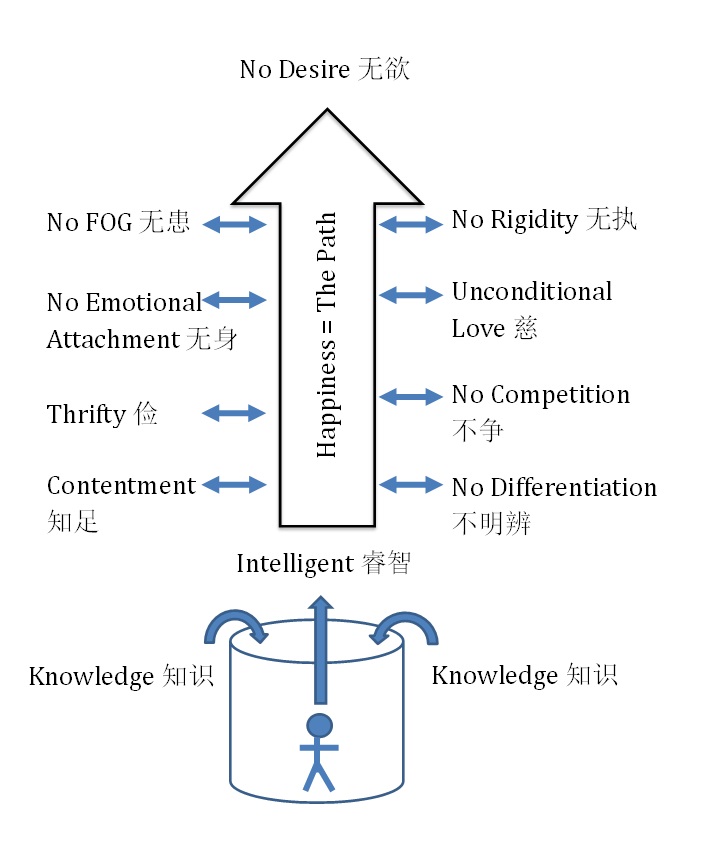
You need to have a lot of knowledge in order to have no doubt about how to live your life to the fullest possible.  Everything holding you to a life you don’t want to live is a prison created by your own mind. Unfortunately, you can’t just wish yourself into a new life. You have to actively work towards that goal if you really want to be free from that prison.

There is a big difference between knowledge and intelligence. People who have little knowledge usually have a lot of fear. People who have a lot of knowledge but little intelligence also have a lot of fear. The fear is always about “have” and “have-not”, “lose” and “lose-not”. When you have enlightened to the perfection of wisdom, you will have no more fear, regardless of how little knowledge you have about this world. When you have no fear, you are totally free.

You are not free because you are held down by your desires. The less desire you have, the lighter you are and the easier you can levitate yourself. You will be happier. The euphoric effects of gaining wealth, colorful things, relationships, fame, luxurious food, leisure are not much different from the production of excess dopamine in your brain stimulated by drugs. These are neither bad, nor good, but you must know the risk of developing a “substance abuse disorder”.

Zeal to differentiate (明辨) right and wrong, good and bad, more or less, beautiful and ugly, long and short, tasty and tasteless, useful and useless, are dangerous thoughts. The comparison can make you unhappy due to envy, jealous, fear, sadness, anger, hatred, intolerance, depression, anxiety, etc. The electrical signals from your six sensual organs are not the sources of your unhappiness; it is the fault of your mind in reacting to the signals. If you are in control of your mind and always choose to react with a happy feeling, you are already on the happiness path. You don’t have to look very far to find the path to happiness. Happiness is the path. Making comparison is warranted only if it doesn’t make you unhappy.

Be contented (知足) with reality which naturally has highs and lows. Wishing to be lucky every day is judgmental and unrealistic. Choosing to be unhappy is unwise. Don’t compete (不争) to be the one who is better, have more, prettier, cleverer, more successful, closer to God, etc. Don’t desire to be right; instead, don’t be afraid to be not-right, so long as you are not wrong.

Be independent. Learn to depend on no one. You are free when you are able to reject all help and have no fear doing so. In the midst of abundance, you will feel happy to help all living things. The natural compassion is a happy feeling; unconditional love (慈) for others is a kind of self-interest. Selflessness is the greatest selfishness; the selfless act will not make you unhappy if it is not an artificial behavior due to brainwashing by religious institution. But you must be thrifty (俭) with your emotional energy because you don’t have infinity energy.

If you have no self (无身), nothing can do harm to you. You come from nothing and you will be back to nothing when you die. Your body and all your properties (in legal terms) do not really belong to you; these are on loan to you. You are free to use them and protect them. You never really lose anything. Your mind is who you are; not your body. If you have no emotional attachment to your body, and to everybody and everything else, you will have no fear. No fear of having and not-having, losing and not-losing. You are able to let go of everything anytime.

You don’t owe anyone anything. You don’t naturally have any obligation to do anything for anyone. Everything happens the way it needs to happen; no human can single-handedly make things happen or prevent anything from happening. There are invisible hands involved: Dao, Heaven, Earth, and People. Don’t worry about what will happen (无患). It is not your credit, and not your fault. You don’t have to feel proud or guilty, if you have no intention to gain anything or to harm anyone. If you have a role in an accident and given a jail sentence by the laws, accept the punishment peacefully. Guilty feeling is unnecessary and has no effect on the reality. Of course, if your crime is motivated by desire for personal gain or the benefit of a love one, then you are possessed by the Dark Side and you will have fear. You are not free, and you will not be truly happy.

Don’t be rigid in your thinking and actions. Contradicting yourself is not a problem to be avoided. Human distinctions of right and wrong are false anyway. Dao changes with time and space. Don’t be arrogant; don’t assume you are right. Learn from various texts, but never assume any of them is sacred and must be obeyed absolutely. Don’t stays empty minded, although nothing is right and nothing really matter; everything is an illusion. Trust your judgment (but not absolutely, 无我执), trust the texts (but not absolutely, 无法执), and trust nothing and nobody (but not absolutely, 无空执). An empty mind will produce wrong judgment, so is an unthinking mind (which follows rules rigidly), and an arrogant mind (which distrust everything and everybody except yourself).

When you experience the happiness of having no desire, you are very near to Enlightenment. All the above attributes will come naturally. You can follow your heart and yet do no wrong. This is the Perfect Wisdom.

Jedi in the Chinese history

Table of Content: HOW TO RAISE A RESILIENT KID: I AM NOT RIGHT BUT THAT’S OK

There were many Daoist “Jedi’s” in the Chinese history who came out from the mountain to save the people from chaos and famine. Below are some of the examples. Don’t admire their successes but appreciate their beautiful hearts and inner peace.

1) Guan Zhong (管仲) (725-645 BC): He was a chancellor and reformer of the State of Qi during the Spring and Autumn period. The Qi State was in chaos. When Prince Xiao Bai tried to take over the throne, he was hit by the arrow of Guan Zhong but cheated death. When he became the Duke of Qi, Guan Zhong was pardoned because his intelligence and knowledge were needed by the Duke. He was later appointed as the chancellor in a grand ceremony. He told Duke Huan: “The way to govern a country is to first ensure the people are prosperous.” (凡治国之道,必先富民。) Through Guan Zhong’s reforms and skillful diplomacy, Qi became the most powerful of the feudal states and Duke Huan became the first of the Five Hegemons. Guan Zhong said: “The benevolent Sage is like the Heaven which covers everybody and gives no preferential treatment to anyone. He is like the Earth which supports everybody and gives no preferential treatment to anyone. Favoritism will create chaos to the country.” (圣人若天然,无私覆,若地然,无私载也。私者,乱天下者也。) “You must give the people what they want if you want to get what you want. If you understand this logic, you own the best treasure of governance.” (知与之为取,政之宝也。)

2) Sun Zi (孙子) (545–470 BC) is probably the most famous military strategist in the world, having authored The Sun Zi Art of War. King Helü of Wu State appointed him as the army general to fight against the much bigger neighboring Chu State. In 506 BC, the Wu State was victorious and captured the Chu capital. Sun Zi said: “The five important factors to win a war are: Dao, Heaven, Earth, Leader, and Ways of Administering the Military.” (一曰道,二曰天,三曰地,四曰將,五曰法。) Lao Zi said: “Dao, Heaven, Earth, and People are interrelated in various ways which existed naturally.” (人法地 地法天 天法道 道法自然。) What they meant was the success or failure of any endeavor depended on all the above factors. Considering only one or two factors, doing things by brute force and against the Dao will end in disaster. Claiming credit as if the success is due solely to a leader is a delusion.

3) Fan Li (范蠡) was born in 517 BC. He and King Gou Jian of Yue State became war prisoners after losing a war against the invasion of Wu State. After three years of captivity the two of them returned to Yue, where Fan Li helped Gou Jian carry out a host of reforms aimed to strengthen the Yue State. In 493 BC, Yue used an opportunity to strike back and destroy the Wu State. Fan Li once told Gou Jian: “Use indirect way if we are weaker. Use direct attack if we are stronger. Exhaust the enemy’s strength and maximize our indirect power to capture them. This is the amazing way to use direct and indirect forces in military art.” (后则用阴,先则用阳,尽敌阳节,盈吾阴节而夺之,此兵家阴阳之妙也。) When Gou Jian wanted to accept Wu surrender, Fan Li stopped him and said: “When the opportunity is presented to us, we must grab it quickly and make no mistake because the opportunity will not come again next time. If we don’t accept what is given to us by the Heaven, we will in turn be punished with disaster.” (得时无怠,时不再来,天予不取,反为之灾。) After the victory, Fan Li resigned and retreated to live a secluded private life.

4) Zhang Liang (张良) (250–186 BC) was the most important military strategist of Liu Bang in the rebel against the cruelty of the Qin Dynasty. After the establishment of the Han Dynasty, he soon retired and became a practitioner of Daoism. Liu Bang once said: “Zhang Liang was able to help me win a war from a thousand miles away from the front line. He is one of the Three Pillars of my victory, along with Han Xin, the grand-general of Han forces and Xiao He, the first chancellor of the Han dynasty.”

5) Zhu Ge Liang (诸葛亮) (181–234 AD) was a young man living in a small cottage during the Three Kingdoms period at the end of Han Dynasty. He was well known for his intelligence by his circle of friends. A warlord, Liu Bei (刘备), heard of his name from someone and went to the cottage three times to finally persuaded Zhu Ge Liang to help establish a strong force. Zhu Ge Liang was instrumental in the war against Cao Cao, resulting in the establishment of the Shu State (蜀国) as one of the Three Kingdoms for Liu Bei, and finally became the chancellor of Shu. One of his famous advices to youngsters is: “Taste the tasteless and stay serene to have a clear view of your ambition. Stay comfortable with being unknown and quiescent to be able to reach a great distance in the future.” (淡泊以明志,宁静以致远。) Don’t chase for fame or wealth.

6) Li Mi (李密) (224–287 AD) was an intelligent Daoist who was known to read while riding a bull. He later became the leader of a civilian resistance army (瓦岗军) against the Sui Dynasty. Xu Mao Gong (徐茂公) and Wei Zheng (魏征) were also Daoists who were senior personnel of the rebellion army. They joined forces with Li Shi Min (李世民) who later became the second Emperor of Tang Dynasty. Li Jing (李靖) was a Daoist who was the general of the Tang army. His answers to military questions from Li Shi Min (唐太宗李卫公问对) were made into one of the Seven Military Classics of ancient China (武经七书). Xu Mao Gong and Li Jing helped the Tang Dynasty to topple the Sui Dynasty, defeated all the warlords, and also defended China against Turk’s invasion. Emperor Tai Zong regarded Wei Zheng as his invaluable mirror who helped him to reflect and prevent him from making mistakes throughout the “Reign of Zhen Guan” (贞观之治) (627–649). Tai Zong became one of the greatest emperors in China’s history and henceforth, his reign became regarded as the exemplary model against which all future emperors were measured.

7) Li Mi (李泌) (722–789 AD) was a trusted advisor to three emperors of Tang Dynasty — Emperor Su Zong, Emperor Dai Zong, and Emperor De Zong. He declined to formally serve in the governments of Emperors Su Zong and Dai Zong. He was finally forced to serve as Emperor De Zong’s chancellor when he was 67 years old. At a young age, he was assigned to teach Dao De Jing of Lao Zi to the princes of Emperor Xuan Zong (father of Emperor Su Zong). He was perceived to have very peculiar behavior, always playful like a child and never look like a learned adult. In 756, the rebel army of An Lu Shan reached Chang An and forced Emperor Xuan Zong to flee to Cheng Du. Li Mi helped Emperor Su Zong to defeat An Lu Shan but he declined the appointment as a chancellor, stating: “I find it much more honorable that Your Imperial Majesty treats me as a guest and a friend, than as a chancellor. Why do you want me to take an inferior position?” He resigned from the government four times, to enjoy peaceful time alone in the mountain, but always summoned back when a new Emperor took the throne. In 784, rebellions by Zhu Ci and Li Huai Guang forced Emperor De Zong to flee to Liang Prefecture. Li Mi helped Emperor De Zong to defeat the rebels. Also in late 787, Li Mi successfully made counter attacks against Tufan (a nomadic tribe) invasion. One of his famous mantras about a Daoist conduct is: “Be straight and uncompromising like serving justice; be flexible whenever possible like applying intelligence in a roundabout way instead of head-on confrontation; move swiftly like a horse in helping people with your skills; be contented to stay unknown and quiescent when the work is done and don’t claim any credit.” (方若行义,圆若用智,动若骋材,静若得意。) Have a strong integrity inside but show flexibility outside; don’t give an impression to other people that you are arrogant, tough, and unsentimental. Feel satisfied with whatever achievement you have made instead of being eager and ambitious to do more.

8) Miao Guang Yi (苗光义) was born around 925 AD. He was the favorite disciple of Chen Tuan (陈抟), a famous Daoist sage in the history. Due to the civil war among the warlords, he lived as a fortuneteller and Chinese medicine practitioner. He later helped Zhao Kuang Yin (赵匡胤) to defeat all the warlords. Zhao Kuang Yin became the first Emperor of the Song Dynasty. Miao Guang Yi was appointed to a high position in the government. However, learning from the experience of Fan Li (范蠡) and Zhang Liang (张良), he tendered his resignation to the Emperor and returned home. He then set up schools and provided free education to the children in his village.


REAL JEDI

Table of Content: HOW TO RAISE A RESILIENT KID: I AM NOT RIGHT BUT THAT’S OK

I wrote this blog with a happy spirit and a lot of joys. My 10-year-old daughter, Yu Rui (玉睿), said that I enjoyed writing it so much that I forgot my meal and sleep. She also enjoyed helping me with English translations of some stories of Zhuang Zi. She is so cheerful and innocent (天真无邪). She can make a fuss one minute ago but start laughing as soon as she watch a crazy funny clip on YouTube. The unhappy thought doesn’t stay in her mind (不住相), like a baby. I have much to learn from her. Of course, she also has much to learn from the world. Every morning, I would tell her to stay crazy. I hope the education system won’t make her lost the precious treasure of cheerfulness as she grows older.

Many children have lost the ability to be cheerful due to the “education” from the schools and the society. They are easily enraged by the “wrong doings” of classmates because of the doctrines of what is right and what is wrong that they cannot change. They have so much intolerance and “allergic” to many people and many things. They are easily sad when they fail to meet their “responsibility” to please the parents, family members, friends, classmates, the schools, and the society. They are afraid to be happy, because they are ashamed to show crazy happy emotions; they are so serious and so worry about their image and what other people think. They mourn for the past, worry about the future, and anticipate troubles. They have a lot of fears, obligations, and guilt (F.O.G.). They have so much desire for success, wealth, fame, external beauty, delicious food and perfect health, so much so that their incomes always lag behind their appetites, so they are always not satisfied with their lives. They have lost the natural contentment and birthright happiness.

My 14-year old son, Lian Zhi (廉智), likes to ask many questions. I have many things to write because of those questions. One time, he asked me: “How to be right all the time?” My answer to him was: “Don’t desire to be right. Instead, don’t be afraid to be not-right, so long as you are not wrong.” Wanting to be right is arrogant. It will only make you unhappy. Stay crazy and stay foolish.

Compassion and righteousness are beautiful things for a person to have because these values can bring happiness to the person. An angry person cannot at the same time be happy. However, compassion and righteousness become ugly when people are demanded to show these values. We must accept the fact that different cultures have different doctrines about what compassion and righteousness mean. What we consider right is the result of mental preconditioning, and other people with different mental preconditioning may consider it to be wrong. If everybody chooses to abandon the desire to be right and the desire for other people to be right, he will not be troubled by criticisms and he will show more humility towards other people. Everybody will be happy and not making other people unhappy.

I hope this blog can help many children to regain the natural ability to be happy and cheerful again.

The Dao is the Way in which the Nature really is. It is unnamable, but we have to give it a name so that we can try to talk about it. It is everywhere; that means it may have different meanings at different time and spaces. If we say it is good, but it is also bad in another way. If we say it is beautiful, but it is also ugly in another way. The terms good cannot exist without bad, beautiful cannot exist without ugly. There are right and wrong, useful and useless, because human thinking makes them so. The Dao encompasses everything, including the existence and non-existence, the known and also the unknown. We have to transcend above the common world if we want to understand it. We can then see reality in the Way it is and have no desire to divide reality into good and bad, beautiful and ugly, right and wrong, useful and useless, or other human ways of distinctions which are all false. We can then accept everything and reject nothing, and live in harmony with the Ways things are. You can’t put a big load into a small bag; nor can you talk to a person who believes in his own doctrines as if he is a wise man. He is bounded by his boundary. You mustn’t believe in your own thought because it may be wrong or bounded by your own boundary. You must be the master of your thought and control the “beast” from taking you for a ride, making you unhappy, or bringing you joy now but make you suffer the consequences of your madness and foolishness. Occasionally, you may use the common distinctions to test the boundary but you mustn’t become limited by the distinctions.

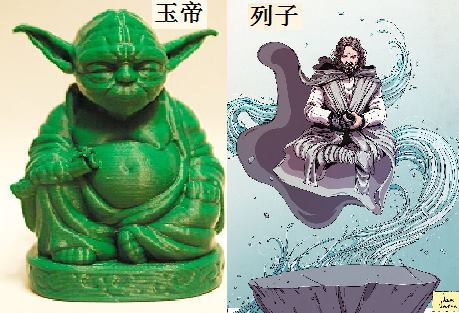
I think the Jedi in the Star Wars movies is a good representation of a Daoist. The character can help clear the confusion about the personal conducts of a Daoist. A Jedi has no desire. He doesn’t wear special costume or look different from ordinary people because he doesn’t want to attract attention. He lives a simple life but that doesn’t mean he has no career. He doesn’t trust the government and doesn’t want to be involved in politics of the high places but that doesn’t mean he doesn’t learn to become intelligent. He needs the intelligent for himself to maintain his sanity in an insane world; not easily fooled or swayed by both the common views and the Dark Side. He doesn’t want to be a member of the government because there is nothing for him to govern; he prefers to govern himself and let the world goes its own way. He wanders carefreely and lives effortlessly; no self-inflicted suffering to his mind. He will learn the lightsaber skill and fight the Dark Side to save the people. However, he will not think of it as an obligation nor has any guilt for failing to meet the people’s expectation. He conforms to the standard of no one, including himself. He has no desire, and no emotional attachment to anybody, including his body. Therefore, he has no fear about death. But he doesn’t wish to die because there is so much fun to live; the changes of the world are like magic shows in front of him and he is always curious to figure out what comes next. He will run for his life if necessary because he is not arrogant; the greatest courage looks cowardice. He doesn’t avoid challenges and hardships of life because he understands the Dao; highs and lows in life are natural and he doesn’t expect only highs. He has no displeasure to face the challenges and hardships. He can feel the Force (Dao); he is one with the Force (Dao), and the Force (Dao) is with him. He enjoys companionship with his fellow Jedi’s. He makes friends with common people too but there can be no emotional attachment. There is nothing he wants to keep and nothing he cannot let go. He will not claim any credit because he has no desire for honors. He wants nothing so that he has nothing to lose. He sees no difference between honors and disgraces because all human distinctions are false. He sees no difference between life and death. He comes from nothing and returns to nothing; like a child who leaves home and then returns home, with no sadness. He loses nothing; everything which he left in this world is like his footprint.

THE PATH IS SIMPLE IF YOU DON’T MAKE IT DIFFICULT

Table of Content: HOW TO RAISE A RESILIENT KID: I AM NOT RIGHT BUT THAT’S OK

Buddha said there is an island of happiness with no suffering (彼岸). If you start swimming, you will probably reach the island. You may get there faster if you receive some helps from a friendly giant turtle (aka a good teacher). You need to let go (布施/舍弃) of everything (let go of external wealth, knowledge, and energy; and let go of emotional attachments to your body and your love ones) and have no desire (无欲), except the desire to reach the island. If you are doubtful, you might give up halfway; then you will never reach the destination. If you have other desire, it will lead you to the wrong direction. The more desire you have, the further you will drift away from the sea shore. If you remind yourself to minimize your desire, you will be able to come back to the sea shore, and you will be able to start swimming towards the island when you are ready.

You must make it a habit to have no desire. Otherwise, you will easily go back to your old self who have some desires. Your swimming effort will be wasted in the one-step-forward and one-step-back actions. You can reach the island of happiness only if you keep swimming in the correct direction. According to Buddha, everybody can do it, i.e. it is not really difficult. Unfortunately, some scholars make it so complex and difficult to comprehend by creating tons of “sacred” texts. They further tell the people that it is difficult, almost impossible, to attain the intelligence of Buddha; not until you have read all the “sacred” texts. It is really a disservice to the people who desperately need help to regain the birthright happiness they were born with.

Dividing reality into thousands of separate things is undesirable, but the scholars do it. Greedy for more knowledge is undesirable, but the scholars teach the people to memorize tons of “sacred” texts. Knowledge is not the same as intelligence; just as food is not the same as nutrients. Digested knowledge can turn into intelligence; nutrients can only be absorbed by your body if the food you ate is digested. After that, the “food” turns into shit which is best to be pushed out of the intestine into the toilet bowl. Similarly, the knowledge can be discarded instead of keeping it in your brain like precious thing, showing it off to people so that you feel proud of yourself, or looking down on people who have less knowledge than you. Feeling proud is incoherent with the characteristics of an enlightened person like Buddha. The best sacred text has no word in it. Buddha said: “If a sacred text is said to belong to Buddhism, then it is not a sacred text of Buddhism.” (所谓佛法者,即非佛法。) “Whatever the Buddha said cannot be used as a doctrine and cannot be told to others as such. The ultimate truth cannot be written down in words but it doesn’t mean there are no words that can point you to the ultimate truth.” (如来所说法,皆不可取,不可说。非法非非法。) Whatever the Buddha said was neither truth nor falsehood. “If someone says a Sure Way to achieve Enlightenment is said by the Buddha, it is actually a slander. It is because he cannot understand what I said. My dear disciple, Subhuti! For the so-called Way of Saying It, there is really no way to say it. That is why it is called a Way of Saying It.” (若人言:如来有所说法,即为谤佛,不能解我所说故。须菩提!说法者,无法可说,是名说法。) Buddha would not keep it as a secret; unfortunately, no one can be told what the Way is. He could only point out the direction. One will have to find his way and experience it himself.

Lao Zi said: “Dao that is described by anyone will never be the correct or complete description of Dao, because the true Dao is all encompassing and has unlimited extent that it can never be fully described with words.” (道可道也,非恒道也。) Dao can only be learnt and cannot be taught. Knowledge can be transferred but intellect can only be learnt by the individual himself.

Every -ism is a wasn’t. The -ism that people talk about today wasn’t the original idea in the minds of the venerated Sages who have died a long time ago; it is just their waste matter. Zhuang Zi said: “I have said so many things in my life but I’ve never actually said a word.” He didn’t agree or disagree with any thoughts, including his own thoughts. How can anyone agree or disagree with him? You can’t agree or disagree with him when he has never said a word but noises/music. The truth transcend conceptual sphere of right and wrong. You must not think in terms of right and wrong if you want to understand the Dao. If you don’t understand the Dao, you can’t agree or disagree with the Sages.

Zhuang Zi said: “The bait can be thrown away after the fish is caught. The trap can be thrown away after the rabbit is caught. Words are used to transmit thoughts. After the thoughts have been transmitted, the words can be thrown away from our brains.”

Perpetual happiness is what we want to achieve. We cannot have it if we have no freedom – freedom from the bondage of passions, freedom from the distress we inflict upon ourselves through our ignorance, and ultimately, freedom from the suffering of birth and death. We cannot have freedom if we have desire. How can we achieve self-levitation if we load ourselves with material things, bodyweight, emotional attachment, and knowledge? Desire to have all these things will certainly tie us down.

Freedom means you can have it your way whenever you want it. When you want it, the Buddha is like already here (如来), right inside your heart; he comes from nowhere, and not going anywhere (如来者,无所从来,亦无所去,故名如来). In other words, you are the Buddha, after you have liberated yourself. Freedom (自由) means you can do everything naturally (自然) without thinking, like a baby; you can do what your heart tells you to do, without restraint, but yet do no wrong (能从心所欲,不逾矩). Confucius said: “Is compassion far away from us? Whenever I want compassion, I can immediately show compassion.” (仁远乎哉?我欲仁,斯仁至矣。) Compassion comes from within, do not seek it elsewhere. Don’t desire to be benevolent so much so that you become unfree and unhappy and cause the negative impacts to stay (住) in your mind for a long time; instead, let go or give away (布施/舍弃) the extra things that you don’t need for the purposes of compassion and righteousness, and forget what you just did instead of feeling proud about the generosity (若菩萨不住相布施,其福德不可思量). Express compassion and righteousness naturally, i.e. from the heart; if you do it simply because you have been indoctrinated to cherish compassion and righteousness, you will have F.O.G. Sympathize but don’t share the sadness and pain of other people (乐而不淫,哀而不伤,怨而不怒); remain peaceful within at all time. Hurting yourself is an act which goes against the Nature; it is probably the only wrong thing to do in this world, everything else is just not right but not wrong too. If you are not happy, you can’t help others; you will probably mess up and do more harm than good (好心做坏事). If you see someone drowning, and you know how to swim but you don’t have the life-saving skill, trying to help will only end up with two drowned persons.

Must you have a “successful” career (有为) in your life? I don’t know about that, but I think life is meaningless if you are unhappy. The Diamond Sutra (金刚经) said that the real Buddha’s Ways have no fixed rules; if someone says you must do this and mustn’t do that, then the rules are not really the Buddha’s Ways; the actual Ways cannot be expressed in words. (佛说般若波罗密。即非般若波罗密。是名般若波罗密。) Prajnaparamita or the perfection of wisdom cannot be considered as perfect wisdom if you are still bound by rules. The Buddha himself did not follow any rule to achieve the Enlightenment. (如是!如是!须菩提!实无有法如来得阿耨多罗三藐三菩提。)

Lao Zi said: “Don’t talk too much on what is Dao because the more we talk the more it will deviate from the true Dao as we become fixated with perceptions. A person who assumes he knows everything and tries to prescribe a standard way of life for everyone is not wise and doesn’t really know Dao.” (知者弗言,言者弗知。) The cleverness of the scholars is only useful to cheat people and avoid being cheated. It is good to have but not essential for your happiness. Opportunistic clever tricks and desire for benefit should be discouraged if theft and robbery are to be abated (绝巧弃利 盗贼无有). You don’t have to admire the clever scholars or feel worry for not learning the cleverness (绝学无忧). Practice the knowledge of knowing and also the knowledge of not knowing; don’t complicate your mind with too much unnecessary knowledge which then makes you worry about the future or anticipate trouble. Intelligence is what you need, for your freedom, and happiness. Everybody can have this kind of intelligence. Learn the intelligence from all sources and don’t limit yourself to Buddhism sacred texts; all the truths can be considered as the Buddha’s Ways. (是故如来说一切法。皆是佛法。) It is really possible to have an invincible mind and an unbreakable heart. You will then be free of all mental sufferings and burdens. (金刚者坚不可摧,能断一切烦恼和执着。)

Liberate yourself and start swimming to the island of happiness. Everybody can do it; so do you. I’m trying to free your mind. But I can only show you the door. You’re the one who has to walk through it.

EMPATHY AND COMPASSION

Table of Content: HOW TO RAISE A RESILIENT KID: I AM NOT RIGHT BUT THAT’S OK

Empathy means the ability to understand and share the feelings of another. Compassion means sympathetic pity and concern for the sufferings or misfortunes of others; it doesn’t mean you share the suffering feelings of another. Buddha must have seen countless of people who were suffering from all kinds of misfortunes. He had great compassion for them, but never empathy; otherwise he would have died of broken-heart and not lived to 80 years old. You don’t have to take responsibility for the suffering of anyone.

If two things are tied together by a rope, there is then a physical connection between the two. When something happened to one of them, the other will feel the force or tension. A child is connected to his mother only when he is still a fetus in the mother’s womb. After he is born, there is physically no more connection. The fact that he is the son to his mother will never change; it is a linguistic definition. However, whatever happened to him should have no effect on his mother. Unfortunately, we often choose to “see” that there is a connection between us and our children. The connection is a virtual one; i.e. the connection actually isn’t there, but we choose to fool ourselves and trick our minds to “see” that it is there; hence we share the feelings of our children. The same happens to all other kind of relationships. We develop empathy for our parents, spouse, family members, friends and even strangers. The empathy is really unnecessary; when someone feels sad, there is no good at all for another to share the sadness. Demanding for empathy is an act of selfishness and bullying, like forcing a person to drown together with another. Buddha teaches us to have no emotional attachment to anybody. However, we must show compassion for the suffering, and we must show kindness to help in any ways we can. Expressing true compassion is good for our mental health and also beneficial for the relationship.

You were nothing until the moment you became an embryo in your mother’s womb. The Nature is truly mysterious and fascinating. You then start to have a body when you were born; but after you die, you will be back to nothing. In one sense, you borrowed the body from the Nature. Your body doesn’t belong to you or anybody else but the Nature. Like borrowing a book from the library, you use it carefully but you can’t guarantee its condition will not deteriorate. (You can’t buy the body because the Nature has no desire to sell it, and your money is also borrowed from the Nature anyway. The Nature has no desire for anything from anybody.) By the time you are required to return it, you must let go and have no desire to keep it any longer. Having no desire to keep your body doesn’t mean you give it up now. Before the due date, you are free to use it for your happiness. Similarly, the relationships with your parents, spouse, children, family members, friends, and everybody else do not belong to you. However, you don’t have to give them up now but use them for your happiness. When the time is up, let them go without any feeling of sorrow. I don’t think Buddha ever felt sad for the death of anybody; of course, it doesn’t mean he felt happy either.

You may think it is easy to say but difficult to do since you are not Buddha; but it may not be as difficult as you think. It is a matter of mindset change. When someone lost a diamond, you will not feel sad because the diamond doesn’t belong to you. When you lost a diamond, you will not feel sad if you never have the desire to keep it simply because you don’t see the diamond as a precious thing, and you are mindful that it doesn’t belong to you. You will see diamond as a precious thing only if someone else assigns a high price to it. In other words, you are tricked by someone to see diamond as a precious thing. Nevertheless, you may have many tools at home although they are not precious. Do feel free to use them for your happiness. If you can pick up something, there is no reason you can’t put it down (拿得起放得下). It is a matter of whether you want to put it down, or you are unwilling to put it down because you want to keep the “precious” thing.

Qin Shi attended the funeral of Lao Zi. He made a few crying sounds and left. One of the disciples of Lao Zi asked: “Were you not the Master’s friend? Is it then sufficient for you to mourn no better than you just did? You don’t seem to feel sorrow for the loss of a friend.” Qin Shi replied: “I am certainly a friend of Lao Zi. My expression just now to send him off is appropriate. When I came to mourn, I found many people crying out loud although they were not relatives of Lao Zi. This is the kind of punishment on people who go against the Nature, entirely due to the ignorance of themselves. The Master came at his right time into the world. When his time was up, he left the world peacefully without any hesitation. It goes perfectly in harmony with the Nature. Our sorrow or rejoice have no effect on his mind. He is naturally free of emotional attachment and suffering. This is what our ancestors called the great relief from all punishments of being hanged upside-down. Therefore, there is no need for me to feel sorrow.” He who awaits his time, who submits when his work is done, in his life there is no room for sorrow or rejoice.

A disciple asked Confucius: “In the funeral of his mother, Meng Sun Cai cried without tears. He didn’t feel sad and showed no sign of sorrow. However, he is widely known in the Lu State as an expert in funeral ceremony. I suspect that he doesn’t really have the substance despite the fame. Am I right or wrong?” Confucius said: “Meng Sun Cai is really a subject-matter expert. He has done everything perfectly according to the funeral requirements. The ceremony should be simplified but the society refuse to change. Anyway, Meng Sun Cai has done some simplifications. He doesn’t want to harp on about why we live and why we die. He doesn’t care whether he will die earlier or later than his peers. He leaves it to the Mother Nature to make the arrangement; and wait patiently for the forthcoming changes which he has no way of knowing in advanced. When the changes happen, what good is there to prefer no changes? If the changes don’t happen, what good is there to wish for changes to happen? You and I have been dreaming for so many years and yet to wake up! To Meng Sun Cai, changes to the body will not affect his mind. Death is just a migration of a person’s spirit to an unknown world. Meng Sun Cai is an enlightened person. He complied with the requirements of funeral ceremony and cried along just to satisfy the societal practices. Is the body which is dying really me or just an avatar of me? Should I feel sad for the changes to the body which is just a vehicle (and not really who I am)? You dreamt of being a bird flying in the sky, or a fish swimming in the river. You speak as if you are awake now, but how can you be sure that you are not in a dream at the moment? Stay peaceful all the time and let the Mother Nature makes all the arrangements. Forget about life and death, success and failure.”

Zhuang Zi’s wife was dead. When Hui Shi went to the funeral, he saw Zhuang Zi beating a drum and singing. Hui Shi said: “Your wife lived with you and raised your children for you. She became old and died. Not only you don’t cry but you beat the drum and sing. Don’t you think that is improper?” Zhuang Zi said: “Not really. Let me explain. Soon after her last breath, how could I have no emotion at all? However, after calming down later, I recalled that we had no life at the beginning. We didn’t even have a body. In the vagueness of the Nature, the unknown natural changes gave rise to our bodies and then we became alive. The death of my wife is as natural as the four seasonal changes in a year. She has returned to her original form and is now resting peacefully in the giant bedroom of the Nature. If I cry out loud, it will disturb her sleep. Then, I am being rude and unreasonable for not understanding the nature of lifecycle. Therefore, I choose to stop crying.”

You should start learning to have no desire (无欲) now; no desire for emotional attachment to your body or anybody. Having no emotional attachment doesn’t mean you can’t keep what you have; it means you can give it up anytime with no hesitation. It will be difficult to do it if you haven’t been practicing the mental preparedness. You can love everybody and wish the Mother Nature is kind to you; but you will not feel sad if you are mentally prepared to see your wish being rejected by the Mother Nature, like not winning a lottery. You can feel very excited in playing a computer game, but you will not feel sad if you are mentally prepared for the eventual game over. Life is just a game; have fun with it, but don’t let fun turns into sorrow just because the game has to end. Life can have a series of sad moments if you indulge in too much desire, too many competitions, and too much possession. Hope is nevertheless an indulgence.