THE GREATEST BENEVOLENCE NEEDS NO GIVING

Table of Content: HOW TO RAISE A RESILIENT KID: I AM NOT RIGHT BUT THAT’S OK

Bian Que (扁鹊) was a famous doctor in the history of Chinese Medicine. The King of Wei State asked him: “I heard that the three brothers of your family are skillful in Chinese Medicine. Can you tell me who the best is?” Bian Que replied: “My eldest brother is the best, my second brother is the second best, and I am the inferior.” The King was surprised and asked: “Then, why you are the most famous but very few people hear of your brothers’ reputation?” Bian Que explained: “My eldest brother can cure a patient before the symptoms start to show up. The patient never knew he had any disease, like he had been healthy all the time, so he didn’t know he was ever cured by my eldest brother. Therefore, nobody knows his exceptional ability. My second brother can cure a patient as soon as the initial minor symptoms start to show up. His patients thought that the illnesses were minor and never knew that the early-stage illnesses could become critical if left untreated. Therefore, everybody thinks my second brother can only cure minor illnesses. My skill is inferior because I can only cure a patient when his illness becomes critical. I can sometime resurrect a dead patient back to life, by chance. Therefore, I become famous in the world. In reality, the highest ability is to prevent illnesses before a patient shows any sign of illnesses; but his ability will never be appropriately appreciated and he will never become well-known. The ability to cure a patient when the illnesses are still in the early stages is often mistaken as mediocre skill because the patients thought that my second brother could only handle minor illnesses. His name is only known to the villagers. When a patient is saved from a critical condition, although he can stay alive but his body functions will never fully recover; and relapse may occur. However, I become famous in the world as someone who can resurrect a dead patient back to life.”

Most people tend to have upside-down view about reality. For example, they think the best life is being intelligent and also being well-known as an intelligent person. A truly intelligent person doesn’t need and doesn’t want to be well-known; he only needs to satisfy himself for having an intelligent mind (like the eldest brother of Bian Que).

Prevention is better than cure. It is best to take good care of our health than to expect the “healthcare” system (which is actually medical-care and a poor substitute for real healthcare that is associated with hygiene, proper diet, exercise, and lifestyle) to save us when we are sick. In addition, a person cannot be considered healthy if he only has a healthy body without a healthy mind. We must attain a healthy mind at a young age and maintain it so that we never need to see a Psychologist or Psychiatrist. When a patient is saved from a critical condition, although he can stay alive but his brain damage will never fully recover; and relapse may occur. No intervention (无为) needed is better than a good intervention (有为). Be the leader of your thoughts instead of being a manager who always need to control your thoughts. Create no negative thought and there will be no emotional disturbance for you to manage. Learn the Dao (道) to have no suffering, instead of the techniques (术) to manage your suffering. Remove the fuel (therefore, no fire can be started) instead of throwing water (or wood) in an attempt to extinguish the fire. Techniques to suppress the symptoms are not the real cure; not until the root cause is resolved.

There was a strange man. His backbone was crooked so much that his head was below his navel. His shoulders were higher than the top of his head. His moustache grew upward. He provided clothes washing and sewing services to earn a living. He also worked as fortuneteller and the income was enough to support the living cost of more than 10 relatives. During war time, he was exempted from army conscription because of his handicap. He walked freely on the street but no army officer would approach him. Sometime, the government would distribute alms to poor people and he would be listed in the group which received the largest amount of alms because of his appearance. A wise person should be able to survive better than a handicap man during chaotic time; otherwise, he is not really wise. A wise person will not be unduly concerned with his ugly appearance or physical handicap; instead the imperfections will spare him from many dangers.

All the toes of a man were severed for breaking a law. One day, he went to see a Confucian. The Confucian said: “You didn’t have good behavior. So, your toes were severed by the government. It is too late for you to come and see me today.” The man said: “Although I have no toes, but there are still many parts on my body which are more important than toes. The purpose I come here today is precisely to learn how to preserve those precious body parts.” The Confucian realized his misdeed and said: “I am so sorry. Please come in to give some guidance and advices to my disciples.” The man was dissatisfied with the Confucian’s self-cultivation and moral conduct. He felt there was nothing worth learning from the Confucian and left without saying another word. A person may have made a mistake in the past, but he can always repent and learn to be an ethical person. His physical handicap (生理缺陷) doesn’t mean he has morality impairment or intellectual disability (心灵缺陷). It is not right to associate physical handicap with sin and shame, and the handicap need not be associated with feelings of guilt. There are still many parts on his body which are more important and precious to preserve.

The Mother Nature is extremely powerful. She gave me physical body; and uses the necessity to live and maintain the body to make me work. She doesn’t need to say a word to compel me to do anything. She uses time to make me turn old and retire; and uses death to make me rest forever. We must accept the changes by the Mother Nature without any resentment. We will then be able to have no fear and see no difference between life and death. The history of time is extremely long; it makes the lifetime of a human being so insignificant regardless of his age.

There were two good friends who understand the Dao. One day, one of them fell ill and another went to see him. The sick one said: “The great Mother Nature has made me as I am! She is causing me to evolve. My backbone is crooked so much that my head is below my navel. My shoulders are higher than my neck. My body is in chaos but my mind is in order.” He dragged himself to the well, saw his reflection, and said: “What a mess She has made of me?” His friend asked: “Are you discouraged?” He said: “Not at all! Why should I be? If She makes a rooster of my left shoulder, I shall announce the dawn. If She makes a crossbow of my right shoulder, I shall shoot a flying bird to make a roaster. If my buttocks turn into wheels and if my spirit is a horse, I will ride around in my own wagon! The Mother Nature gave birth to all of us. We have to accept whatever changes She made of us with neither sorrow nor joy. Like a blacksmith who forges iron, he is free to make the iron into any shape. If the iron disobeys him but demands to be made into a sword, the blacksmith will regard the iron as a bad thing. The Mother Nature made me a human being. If I demand to forever keep the form of a human being, then She will regard me as a bad thing. I shall be ready to be made into any form after I die.” Life is a gift. Look at the silver-lining instead of focusing on the dark spots or grumbling about the unfortunate past. Pain is certain, suffering is optional.

Zhuang Zi saw a skull on the road. He asked: “Did you die because of being greedy? Were you killed by sword in a war? Did you commit a crime and cumber your parents; therefore, you kill yourself? Did you die of hunger or cold? Or you lie down here and die of natural cause?” That night, Zhuang Zi slept using the skull as a pillow. In his dream, the skull said: “All the things you said during the day were the troubles of living men, but I have no more trouble after I die. After death, there is no more superior or inferior, no four-season, and the joy of integrating with the Nature is wonderful. The land of the Nature is my land. The kind of joy is much better than being a king.” Zhuang Zi replied: “I don’t believe your words about the joy after death. I will ask the God of Life to make you alive again; give you back your parents and wife, and send you back to your home. Would you like that?” The skull got a terrible shock and scream: “I don’t want! I don’t want!” Death is a natural end of a person. Nobody knows what will happen after death; and no one ever returns from death and tell us what happened. You should live well in the present moment wisely and earnestly. Focus on what you already have instead of what you don’t or what else do you want. Forget the troubles; instead, remember your favorite things and you will not feel so bad. Worrying about death serves no good at all. It may not be bad after you die; it may be so good that you don’t want to return back to life.

A princess was decreed to be married to the king of Jin state. She felt so heartbroken and cried until her wedding dress was all wet. At the palace of Jin’s king, she slept on an extremely comfortable bed, ate the most wonderful foods from various parts of the world, and finally realized how foolish she was for crying out loud when she left home. Most people are afraid to die. Isn’t that the same feeling as the princess? How do you know you wouldn’t like where you are going after you die? It may not be so bad. Isn’t it foolish to cry out loud, and do all the unnecessary things, when you are not even scheduled for departure?

When Zhuang Zi was about to die, his disciples began planning a funeral. But he said: “I shall have heaven and earth for my coffin; the sun and moon will be the jade symbols hanging by my side; the stars and constellations will shine as jewels all around me. There is no funeral more lavish than this.” But the disciples said: “We fear that crows and eagles will eat our Master.” Zhuang Zi said: “Well, above the ground I shall be eaten by crows and eagles, below it by ants and worms. Why are you so against the birds?” After we die, our body is no better than leftover food. It doesn’t matter how it decomposes. We will be foolish if we assume it will stay fresh just because we don’t see it.
LIFE AND DEATH 生和死

Table of Content: HOW TO RAISE A RESILIENT KID: I AM NOT RIGHT BUT THAT’S OK

During Chinese New Year and other festive seasons, the people love to have fun lighting up fireworks. However, all the dogs will tuck their tails underneath their belly and shivering uncontrollably in their hiding places. Don’t you feel funny and pity for their fearful behaviors? What is there to be afraid of? You may tell them that the light and sound will not cause any harm to them; unfortunately, they will not be able to understand it. They will still feel afraid year after year although they know full well that the light and sound have never hurt them. They continue to feel fearful because they never learn from the experience; they have the knowledge but not intelligence.

Some people are afraid of dark because they associate darkness with the presence of ghost. Don’t you feel funny and pity for their fearful behaviors? What is there to be afraid of? You may tell them that there is no ghost in this world; unfortunately, they will still believe otherwise although they have never seen a ghost. They will still feel afraid year after year although they know full well that no ghost has ever harmed them. They continue to feel fearful because they never learn from the experience; they have the knowledge but not intelligence.

Some people are afraid of death, and prefer not to talk about it. They will still feel afraid year after year although they know full well that nobody has ever live forever. They continue to feel fearful because they never learn from the experience; they have the knowledge but not intelligence. Don’t you feel funny and pity for their fearful behaviors? Sickness and death are parts of life. Feeling afraid will not change the reality. Why then do you want to feel afraid? It is a waste of energy. Your shadow will follow you around whether you like it or not. Hating and trying to run away from your shadow will leave you breathless. Why don’t you turn your attention to something else and stop looking at your shadow?

According to Buddha, (1) the lives of most people are full of sufferings. (2) The sufferings are due to desires which are not fulfilled. (3) One is freed from all sufferings when he let go of the desires. (4) Everyone can do it, by walking on the right path. This is known as the Four Noble Truths. The Noble Eightfold Path can help you let go of all the desires and therefore negate the sufferings. The first step is to have the Right View: to recognize and accept that life is full of sufferings (although there are occasions of happy moments too). You must see and understand reality as it really is, not as you wish it to be. If you wish to have long life and no sickness, you are not facing the reality as you should. If you wish to have no pain in your life, you are not being realistic. Conversely, if all these desires are negated, you will be expecting sickness and death instead of trying to run away from these natural phenomena. You will feel blessed for being healthy most of the time, and the duration of you being in the state of sickness is just a small percentage of your lifetime, and you are lucky enough to die only once. If you choose to inflict distress on yourself by feeling fear, sad, angry, guilty about past mistakes, or worrying about the future, even during healthy times, you are choosing to suffer most of the time in your lifetime. Physically living for a hundred years means you have a short meaningful life if you are suffering most of the time. Physically living for ten years means you have a relatively long meaningful life if you are happy most of the time.

The longest living person in the history lived for 800 years. (Coincidently, Master Yoda also lived for 800 years or so.) There is a type of bug which is born in the morning and dies in the night. It cannot comprehend the concept of one month. There is a type of cicada which is born in the Spring and die in the Summer, or born in the Summer and die in the Autumn. It cannot comprehend the concept of one year. There is a type of turtle where 500 years is like a Spring season; another 500 years is like a Summer season to it. There is a type of tree where 8000 years is like a Spring season; another 8000 years is like a Summer season to it. The bug and cicada have short lives; they cannot comprehend the thinking of the turtle and the tree as far as longevity is concerned. To the bug and the cicada, longevity more than a few years is simply impossible or unbelievable. Similarly, an 800-year-old human is considered having a really short life as far as the turtle and the tree are concerned. Isn’t it laughable if you consider that as longevity? It doesn’t really matter whether you live for 100 years or 10 years; Anybody who claim to have longevity is simply fooling himself (or having a shallow mind) and choosing to ignore the longevity of the turtle and the tree.

Being not afraid of sickness doesn’t mean you don’t look after your health. Being healthy is essential for your happiness. Being not afraid of death doesn’t mean you have to jump down the mountain cliff. Killing yourself is not bravery but plain stupidity for abandoning your future happiness. You had nothing, not even your body, before coming into existence in this world. Everything you have is a bonus; you get to enjoy it like the bank does in the business of safe keeping and investing the deposits of the customers. You don’t really lose anything when the customers withdraw all their deposits. You shouldn’t feel unhappy; instead, you should feel happy to have gained so much profit in the past out of someone else’s deposits. You should feel contented.

Don’t ask what if you get sick but prepare to face it. Nobody is 100% healthy. Expecting perfect health and no illness at all is judgmental. Thinking negatively and worrying that your health will worsen cannot bring any improvement. Instead, the depressing thoughts will worsen the illness and also cause clinical depression (major depressive disorder) if you allow these thoughts and feelings to grow out of control. The secret of health for both mind and body is not to mourn for the past, worry about the future, or anticipate troubles, but to live in the present moment wisely and earnestly. Get help if necessary. Take medications and drugs prescribed by qualified doctors and stop worrying about the side effects.

Think positively. Not every illness needs to be cured with medication; you can usually heal yourself. Not every illness needs to be cured; it may not kill you. You can sometime live with the illness, and die with the illness, instead of dying of the illness. That doesn’t mean you don’t take care of your body. You must eat well, sleep well, exercise well and have good hygiene in order to maximize your happiness; but don’t be afraid to eat anything. Some people live well although they smoke cigarettes, drink alcohol, and drive fast cars. They must be thinking: “Nothing too bad will happen to me.” I am not sure whether they are being too positive. Too positive necessarily means lack of criticality. Being too positive may be equally undesirable as being too negative. You must find a balancing point for yourself. Let intelligence guides you on what to eat or not to eat; and let intelligence guides you to have no fear in making good decisions as well as bad ones.

Sicknesses are changes to your body by the Nature. Whatever happened to the body need not be associated with unhappiness. As long as your mind is still functioning properly, it is possible to stay happy as if the body doesn’t belong to you. Your body, including your brain organ, is like a vehicle to facilitate the functioning of the real you which is your mind; you don’t have to feel unhappy when your car breaks down. If your mind is not functioning, your body will not work even if it is 100% healthy.

STAY AWAY FROM DANGER

Table of Content: HOW TO RAISE A RESILIENT KID: I AM NOT RIGHT BUT THAT’S OK

The King of Song’s State dreamt of a head covered with long hairs sticking through the window into his room. The man told the King: “I am a messenger sent to meet the God of the River. Unfortunately, on my journey, I was accidentally caught by a fisherman.” When the King waked up, he asked a fortuneteller to interpret the dream. The fortuneteller said: “The messenger is a fairy of turtle.” The King sent a few officers to find the fisherman and saved the turtle. The King asked the fortuneteller: “Should I let it go or kill it?” The fortuneteller said: “Kill the turtle and use its shell for fortunetelling.” Henceforth, the turtle was sacrificed. The shell was used for fortunetelling and the results were accurate for a straight 72 rounds in succession. Therefore, the Sage commented: “The fairy of turtle could go into the dream of the King to ask for help but couldn’t escape the net of the fisherman. It has the ability to tell fortune accurately for a straight 72 rounds in succession, but it couldn’t escape the knife of the King. This ability is just cleverness and not intelligent.” Cleverness will get you killed, whereas intelligence will save your life because you know the danger of fire and don’t dare to play with it.

The God of the River asked the God of the Sea: “What is good about learning the Dao?” The God of the Sea said: “Understanding the Dao, you will always be able to react quickly and correctly to the situational changes of the Nature. You can then avoid any dangers from harming you. A forest fire can melt the metal. A massive flood can drown many living things. A person who knows the Dao will always be able to save himself.” You need to know how to save yourself more than how to save the world. Don’t worry about the world; it is more resilient than you think. You can do no good to the world if you are dead.

Once, Zhuang Zi was wandering at a farm. He saw a cicada on a tree, forgetting itself and ignorant of the danger around. A mantis was raising its arms to catch the cicada. The mantis was concentrating on its prey, forgetting that it had exposed itself. A bird took the opportunity and prepared to catch the mantis. Zhuang Zi aimed his slingshot at the bird. Suddenly, he became alert and said: “Oh no! People tend to become ignorant of the danger when benefit is presented to them.” He quickly threw away the slingshot and ran away from the farm. The security guard at the farm saw a man running. He thought the man was a thief who was trying to steal the fruit at the farm. So, he chased and shouted at Zhuang Zi. After getting home, Zhuang Zi was emotionally disturbed for three days. His disciple asked: “Why are you feeling unhappy these few days?” Zhuang Zi said: “I was aiming my slingshot at a bird and became ignorant of the danger to myself. Consequently, I was mistaken as a thief who was trying to steal the fruit at the farm. I’ve made a big mistake.” When people chase for benefit, they often lose the self-conscious about the danger around. We must remind ourselves not to make the same mistake.

The King of Wu’s State went for hunting at a hill. When the monkeys saw strangers, they all ran and hid deep into the forest, except one. That special monkey was not afraid of humans because it was very skillful in jumping from one tree to another swiftly. The King shot many rounds of arrows at the monkey but it could easily avoid getting hit each time. The King then ordered the accompanying soldiers to all aim at the monkey and shot their arrows at the same time. Needless to say, the monkey was killed. The King said: “The monkey was very skillful. However, it lost its life because it liked to show off its skill.” Although you can use your intelligence to overcome the problems that you face, it is best not to show off your special ability too often. When you are overwhelmed by too many problems which are intentionally thrown at you, any amount of intelligence will not be enough to save you. Lao Zi said: “Make light reflection becomes soft and not sparkling. Let dust settles into places. Make sharp edges become smooth. Avoid creating chaos. This is the best equalization.” (和其光,同其尘,挫其锐,解其纷,是谓玄同。) Blend together with the surrounding, smoothen your sharp edges, and don’t attract attention. Follow the norms and rules of the society, live harmoniously with the community (外化), but never let your inner-self to be eroded and become a common folk who is imprisoned by the societal norms and rules (内不化). Be sociable and have a rounded personality (外圆), but never at the price of breaking your principles (内方).

There were at least four times Confucius went to Luo Yang to meet Lao Zi. Lao Zi taught Confucius many things. In one of the meetings, when Confucius thanked and bid goodbye to Lao Zi, he was given two advises. In the first advice, Lao Zi said: “The classics you are studying and teaching are mostly written by the ancestors. They are already dead; even their bones had already decayed. What they have left to you is only their waste matter and not what was in their minds. You should not regard their words as some sort of unbreakable dogma.” In the second advice, Lao Zi said: “A good merchant does not show his goods but pretends that he has nothing. A man of utmost virtue is very simple and looks like a fool. You should get rid of your pride, greed, ego and high ambition; as those things are bad for your mind and body.” Confucius then left with a thankful heart. He returned to his place and always praised Lao Zi. He said: “I know fish can swim but they will be hooked by the fisherman. I know birds can fly but they will be downed by the hunter’s arrows. I know beasts can run but they will drop into human’s nets and traps. But I cannot understand the dragons because they can fly into the sky and stay in the clouds. I have recently met Lao Zi and he is like a dragon; so deep… so profound…”

FREE YOURSELF FROM SUFFERING

Table of Content: HOW TO RAISE A RESILIENT KID: I AM NOT RIGHT BUT THAT’S OK

Master Yoda, Obi-Wan Kenobi, and Luke Skywalker didn’t die; they gave up themselves to integrate with the Mother Nature (羽化). They become free from the cycle of birth and death – Parinirvana (涅槃). They can come and go as they like (如来); because they come from nowhere and not going anywhere (如来者,无所从来,亦无所去,故名如来) like the Mother Nature. The super-entity is one entity; there is no more differentiation between Me, People, Animals, and all Living Things (with limited lifespan). (若菩萨有我相。人相。众生相。寿者相。即非菩萨。) There is no more earthly desire or concern. If the Mother Nature has any feeling, then it will also turn old like all living things (天若有情天亦老). The Mother Nature has no preferential love; it cares for all things in the universe equally and no selected group receives special care. It treats all things like straw dogs used as offering in sacred ceremony (天地不仁 以万物为刍狗). The Buddha has no intention to transfer intelligence to all the people (汝等勿谓如来作是念:我当度众生) and free them from life suffering. Intelligence can only be learnt by individuals themselves. The Buddha will never claim any credit. The people must learn the personal accountability to become self-reliant. The Sage will never claim any credit for the success of the people (为而弗恃也 成功而弗居也 夫唯弗居 是以弗去); the Sage will retire after he has accomplished his task (功遂身退 天之道也). The Buddha and the Sage have no desire; instead, they wish to own nothing so that they have nothing to lose.

The ultimate objective of all religions is to help each and every follower to become a good person of the world; not just as a good person of his religion (with biases toward his own religion against other religions). When you truly become a good person, you will not continue to think that you are a follower of a particular religion, because you will love everybody equally; no more differentiation between Me, People, Animals, and all Living Things (with limited lifespan). The originators created their methods from nothing. There are differences in the methods used by all the great leaders, but there is no difference in the ultimate objective. (一切贤圣皆以无为法而有差别。) There is no fixed method to achieve the ultimate objective; but there are different methods that we can follow (有不是实有,无不是实无). If you think your methods are right, obviously you will think the methods of other religions are wrong; if you think no fixed method really means there is no good method, evidently you will become bewilder; and you will experience the sufferings of birth and death. (以有为有,以无为无,则必然有生有灭。)

On one fine day, Zhuang Zi was fishing beside a river. The King of the Chu’s State sent two officers to visit him. An officer said: “Our King wishes to entrust the country in your hands and makes you the Prime Minister. Would you please come with us?” Zhuang Zi said: “I heard that the Chu’s State had a sacred turtle. Its shell is placed in a shrine and used for fortune telling purpose. May I ask you: do you think the turtle willingly sacrificed so that its shell receives high respect from the people? Or it would rather choose to live and turn its body in a muddy pond?” The officer replied: “It would surely choose to live and turn its body in a muddy pond!” Zhuang Zi said: “Very well! You can now go back home. I also choose to pull along my tail and turn my body in a muddy pond.” Your life is much more valuable than the so-called “honor” which is highly desired by the common people. Dying or suffering for the sake of “honor” is unwise. The “honor” will be a burden to you instead of a precious thing as you are mis-educated to believe. You can live happily without it, but the bait lures you to waste your energy and life to get the useless junk in the end. You are made to believe that you have reached a higher position, but in fact you are actually going further away from the Dao.

Another day, Zhuang Zi was invited to become a minister in the government. Zhuang Zi said: “Have you seen the sacrificial cow? It is fed with the best grass and beans. Its body is covered with beautiful cloth. However, there will be a day when it is brought to the shrine for sacrificial ceremony. At that time, although it wishes to go back to the wild and become a lonely cow, it may not be able to do as it wishes.” You may think that you can quit whenever you wish, but you may not have the freedom to do it when the time comes.

More often than not, the obvious solution is not the best solution. When everybody thinks that a successful career is the primary measurement of a happy life, chasing career achievement or envying the success of rich individuals will actually make you unhappy. An unhappy life cannot be considered as a successful life. You must be fearful when others are greedy; you must take a contrarian stand instead of following the crowd. Some people think that having no desire is a boring and bitter life. It is actually quite the contrary. When you have desire, you will whip yourself to do a lot of work in order to satisfy your desire. The level of desire will increase, and you will then need more to satisfy the higher threshold level below which you cannot feel happy. It is like opium addiction. Therefore, you will whip yourself harder, and feel unhappy along the journey until and unless the threshold level is exceeded; not to mention that you will stay unhappy for the rest of your life if you can never achieve the successful career which you long for. All the problems which you face may seem so complex and difficult to solve. Actually, the solution is quite simple. With a switch in mindset to become no desire, all the problems will suddenly become irrelevant to you. The so-called problems become not your problems, or not even a problem anymore. You are totally free; someone else’s problems shouldn’t affect your happiness. Disorders in this world are parts of the reality; expecting zero disorder is being judgmental or being a perfectionist. Therefore, disorders are not really a problem, and do not require your desire to meddle around. Fearing to see disorders is the problem; the solution is to have no fear because there is no problem for having disorders. The greatest defect is perfection. By having no desire, the threshold level to attain happiness is very low. Every little victory can make you happy. You don’t have to do too much and yet you will be happy every single day.

A giant phoenix flies a few thousand feet in the sky. Everything on the ground looks so small. If everything look small to you, that means you have the vision of the giant phoenix. Success, failure, rich, poor, beautiful, ugly, fame, pain, illness, old-age, death, and practically nothing impress or disappoint you. That is the right thing to do for our happiness. Don’t take anything seriously.

STAY CRAZY AND STAY FOOLISH

Table of Content: HOW TO RAISE A RESILIENT KID: I AM NOT RIGHT BUT THAT’S OK

Trying to accurately distinguish right and wrong (明辨是非), good and bad, is undesirable. Sometime, you think you know the right thing to do for the people but you may not be right; therefore, you should never feel that you must do something. It may be better that you don’t do it, or you don’t have the time or energy to do it; it may be a blessing in disguise that you finally didn’t do it. Don’t regret that you didn’t do it. Sometime, you think you have done something wrong but you may not be entirely wrong, or you may be proven right in the future. Crazy people do crazy things and bring changes. The disruptions to status quo often bring short-term discomforts but the overall results may not be so bad. Therefore, never feel guilty when something goes “wrong” if you have made the decision with pure heart and full faith. Stay crazy and stay foolish. You are a free person. You are free to do what you want to do (so long as it doesn’t infringe on someone’s rights), and you are free not to do what others expect you to do. You are really free if you allow yourself to make good decisions as well as bad ones. Don’t question who was right and who was wrong but face it with courage. After all, human distinctions between right and wrong, good or bad, are false.

“Choice” is a delusion. We often feel edgy when we are presented with choices. It is likely that a decision has been made for us in advanced by “The Matrix”. What we are doing is simply abiding with that decision and proceeds to take that choice, ignorant of the role of “The Matrix”. We then ignorantly feel proud for our right choice, or regret for our wrong choice. The truth is the course of Nature is not dictated by our choice. Things can go wrong as possibly as they can go right. – Murphy’s laws. The roles of Dao, Heaven, and Earth must not be underplayed; lest we become arrogant. The certainty of right or wrong choice is a delusion. “Choice” is the problem; don’t take it seriously. Of course, this is a crazy idea.

The greatest lie that you can tell is the lie which fools everybody including yourself. You believe your own lie as the truth. It is likely that everybody is telling lies unconsciously, unless he is awaken. Fear leads to anger. That means God has fear if It ever become angry. It will die like everything else which has emotion (天若有情天亦老). Everything that has a beginning will have an ending. Nothing is permanent.

If you know you are crazy, it means you are not really crazy. Crazy people don’t know they are crazy. If you know you are foolish, it means you are not really foolish. Foolish people don’t know they are foolish. Confucius was crazy to peddle his ideas which nobody wanted during his time. He was rejected by the kings and ministers of many states, like a homeless dog (丧家之犬). He persevered although he knew there was little or no indication of success (知其不可而为之). He said: “Sweet grass herb grows in the forest but doesn’t stop releasing fragrant smell just because there was nobody around (且芝兰生于深林,不以无人而不芳).” Be who you are and say what you feel.

When Confucius traveled to the city of Kuang, the people there mistook him as Yang Hu who was a thuggish minister. Confucius was surrounded and stranded. Confucius told his disciples: “Don’t worry. Keep listening to my lectures.” A disciple asked: “Master, why are you not afraid?” Confucius said: “Swimming in the river and not afraid of crocodile is the courage of fishermen. Walking in the jungle and not afraid of wild animals is the courage of hunters. Fighting in the battlefield and not afraid of enemy’s swords is the courage of knights. Knowing the going of life (命运) naturally has up and down; therefore, not afraid to face disastrous moments in life is the courage of the Sages.” Not long later, a leader of the rioting crowd went in and apologized to Confucius for the mistake. The riot was then disbanded. This is a story told by Zhuang Zi about a true historical event. It shows the respect of Zhuang Zi for Confucius. A great leader has no fear for his safety, because he is not afraid to die. He lives as he should, releases pleasant smell as he is, and not worry about what will happen to him tomorrow. He may be thinking every day about creating a better future for the people he loves, but he never feel worried about what will really happen. (《孟子•离娄下》: 君子有终生之忧,无一朝之患也。)

A disciple asked Lao Zi: “I don’t think Confucius can be regarded as a highly intelligent person. He has so many disciples, and he has gained so much fame. Doesn’t he know that a highly intelligent person views fame like a pair of handcuffs?” Lao Zi said: “That’s right. Why don’t you help him to remove the handcuffs?” The disciple said: “He keeps thinking about saving the world. That mentality is likely a punishment from the Mother Nature. Since the Mother Nature wants to punish him, how can I possibly help him to escape the constraint?” Zhuang Zi knew Confucius was genuinely trying to save the world and not thinking about becoming famous. However, Confucius didn’t mind the burden of fame but continued his endeavors. Unfortunately, some people look at fame as a precious thing and aim for it; therefore, they don’t mind enduring the various tortures to their mind and body simply for the sack of becoming famous. The difference between them and Confucius is the mindset. Zhuang Zi also thought of saving the world; hence, the beautiful writing of so many humorous parables and anecdotes. The masterpiece was regarded as one of the greatest literary works in all of Chinese history, and many famous writers were influenced by Zhuang Zi, in terms of his philosophical and literary skill, for more than 2000 years from the Han dynasty (206 BC–AD 220) to the present. He also had many disciples, but he didn’t go around selling his ideas to the kings and nobles. To him, doing or not doing something should be spontaneous behaviors or actions, i.e. carefree wandering (逍遥游). He was one with “the Way” and “the Way” was with him.

Yi Er Zi (意而子) asked Xu You (许由): “How is your life living in the mountain?” Xu You asked him back: “What are you doing here? Aren’t you working for Emperor Yao (尧)? After so many years, what did Emperor Yao teach you?” Yi Er Zi replied: “Emperor Yao taught me to work hard for compassion and righteousness, and accurately distinguish right and wrong.” Xu You said: “That means Emperor Yao has pierced tattoo on your face; using compassion and righteousness to harm your face, and using right and wrong to cut off your nose. Don’t you notice that? Do you think you can still come to the road of Nature and wandering in a carefree manner?” Yi Er Zi said: “Please give me guidance! Can you teach me how to wander at the edge of Dao?” Xu You said: “When your eyes are blind, how can you still see colors?” Yi Er Zi said: “After Wu Zhuang learned the Dao, she forgot she was beautiful. After Ju Liang learned the Dao, he forgot he had great strength. After Emperor Huang learned the Dao, he forgot his cleverness. These examples show that the Dao can be learnt if one practices with strong determination. Who knows it wasn’t the intention of the Mother Nature to pierce tattoo on my face in order to make me repent and rest?” Xu You said: “Oh, the great Mother Nature. You created the cold wind in the autumn and caused harm to all things on Earth, but it was not because you have maleficent intention! You created the rain in the spring and gave lives to all things on Earth, but it was not because you have benevolent intention! You carved out a myriad of shapes for all the things, but it was not because you intent to show off your skills. Yi Er Zi! If you want to wander on the Dao of the great Mother Nature, follow me this way!” Forget about what has happened in the past; the bad incident may be a good cause to make you change your way of life for a better future; otherwise, you will continue to stay in your comfort zone. Look at the silver lining; even the worst events or situations have some positive aspects. Learn from the Mother Nature; don’t be maleficent, and don’t desire to be benevolent so much so that it causes suffering to you (such as feeling fear, obligated, guilty, sad and angry). Earth provides enough to satisfy every man’s needs, but not every man’s greed. Help the people who need help, instead of those who simply want to accumulate more things because they are greedy.

Being brainwashed by Confucianism is not necessarily a bad thing; at least it is better than being brainwashed by the Dark Side. However, Confucianism teaches us to work hard for compassion and righteousness, and accurately distinguish right and wrong. The sense of responsibility impregnated in our brains cause a lot of suffering to us in terms of mind and body. We are not really born with the responsibility to help other people. We must instead help ourselves and free us from the punishment we inflict on ourselves. Lao Zi said: “The best benevolence looks like no generosity is given; The whitest cloth looks like it is contaminated; The widespread benevolence looks like not enough is done; The sturdy benevolence looks like the creator is lazy to make it perfect; Naturally existed quality looks impure or tainted; The biggest square has no corner; The biggest apparatus never will be completed; The best music does not need to be loud; The biggest appearance has no shape; Dao is so far-reaching but it is not famous or well-known; Therefore, harmonizing with Dao is the only way to have good start and ends with good outcomes.” (上德如谷 大白如辱 广德如不足 建德如偷 质真如渝 大方无隅 大器免成 大音希声 大象无形 道褒无名 夫唯道 善始且善成。) Don’t try to become a “perfect” person according to the common standards. Don’t be limited by the four corners of a square box drawn on the ground enclosing you within. Be benevolent but don’t desire to become famous and lose your freedom. Don’t become a useful apparatus to the society when you can choose to be a human. The best outcome is when your happiness is not sacrificed in the course of helping other people.

BE YOUR OWN LEADER FIRST

Table of Content: How to Raise a Resilient Kid

Meng Zi (孟子) said: “The people should be considered as the utmost importance. The country comes second; and the king is the least important.” (民为贵,社稷次之,君为轻。) You should work for the interest of the people (workers and customers) first; then the organization, but never specifically for the interest of the boss. When the people are happy, the organization will benefit; and the boss will get his profit. Conversely, maximizing the boss’s profit will jeopardize the interests of the organization and the people.

Confucius told the king of Lu state: “If the king treats the people with respect, the people will work with the king with honesty and loyalty.” (君使臣以禮,臣事君以忠。) The higher is your position, the more you need to show respect, forgiveness, trustworthy, hardworking, and benevolent (恭、宽、信、敏、惠) to the people, so that the people will work with you with honesty and loyalty.

Meng Zi told the king of Qi state: “If the king treats the people like his arms and legs, the people will love him like their stomachs and hearts. If the king treats the people like dogs and horses, the people will treat him like an ordinary person. If the king steps on the people like soil and grass, the people will see the king like an enemy.” (君之视臣如手足,则臣视君如腹心;君之视臣如犬马,则臣视君如国人;君之视臣如土芥,则臣视君如寇仇。) Love the people the same way you love your arms and legs. Is it good or bad to have a non-democratic government (but meritocratic) which behaves like a parent who loves us? Is it better to have a democratic government which is dysfunctional? Is it better to have a Libertarian government (laissez-faire, nonintervention, anarchy) which doesn’t care about the success or failure of the people?

The shadow of a person was unhappy that it is not free to decide when to walk and when to stop; when to sit and when to stand. Anyway, it said to itself: “What to do? I rely on the person. The person relies on something else. A snake relies on scales to slither. A cicada relies on wings to fly. When they are dead, the scales cannot slither and the wings cannot fly by themselves. One cannot be totally free if he relies on something.” When you rely on someone, that someone probably also relies on you. Both are not free. To be free, you must have no reliant. Your mind is who you actually are. Your mind relies on your body to live, but your body will not be able to move without your mind. But your mind never thinks of relying on your body. That is the meaning of natural relationship. Don’t think of relying on the people and don’t think of not relying on the people, because you and the people are one combined entity; i.e. the greater-self. You will never be totally free, but you can be mentally free if you don’t think about relying on anyone or anything to live. Love everyone around you, because they are parts of your greater-self.

Learn to become independent. You must know how to lead yourself first, to live as a free individual who rely on no one, before you can lead others. Love your arms and legs, and make them strong, instead of fat. A great leader loves the people as himself, therefore he lead the people to become independent and leaders in their own rights. A self-serving leader does not deserve to be a leader and will not be loved by the people. That means not loving the people is akin to not loving himself.

A wild chicken may have difficulty to find foods from time to time. It may only find a worm in ten feet, and find a little bit of water in a hundred feet. However, it still prefers not to be locked in a cage in which it will have no worry about foods but it will lose the freedom of wandering in the wild. It is not difficult to have financial freedom if you don’t have much desire. Financial freedom does not necessarily mean you need to have a lot of saving. You can be free when you don’t have to rely on anyone. If you wish to be looked after by someone or the government, you will have to live in a “cage” with no freedom. In return, someone or the government gets the POWER to control your life, including putting you in a cage, mentally and physically. Telling the people to rely on the leader is akin to imprisoning the people.

The duck has short legs, but you can’t lengthen them without making it suffers. The crane has long neck, but you can’t shorten it without causing it pain. What is naturally long needs no cutting off. What is naturally short needs no stretching. You don’t have to feel despair for your short or long; both short and long can be useful. Useless in one way can be useful in another way; it is a matter of using your intelligence to make good use of everything. Similarly, the short and long of other people are none of your business; let the Nature takes its own course. Do you think you know what is best? Do you think the world should conform to your way of thinking? Having the “just cause” doesn’t give you the rights or responsibility to impose your morality or value system on the people. It only destroys the credibility of the “good intentions” because of the inherent desire to change reality into what you want to see. Acts of kindness can only be voluntary, in giving and receiving, without coercion. There may be a lot that need fixing but there is nothing out there for you to fix. Everyone should fix his own problems; of course, he can get some helps if he wants to.

BE HAPPY TO BE WHO YOU ARE

Table of Content

Hui Shi had many skills. The books which he had read can fill up five horse-carts. However, the vast knowledge with inherently wide differences made him incomprehensible. His analyses of problems were sometime incoherent (due to the lack of one fundamental principle to bind together all the knowledge). But he liked to show off his skills and had strong desire for successes and to win in debates. He kept chasing his dreams and never looked back. It is like racing with his shadow. It is so pitiful. Chasing unlimited things (knowledge and successes) with limited life is unwise.

There was a man who hated his shadow. When he walked and saw his shadow following him around, he would walk faster. However, the faster he walked, the shadow moved faster too, right behind him. He thought he didn’t walk fast enough. So, he ran until he eventually became breathless and died. Some people have so many things which they hate about themselves. They hate not being beautiful, clever, wealthy, famous, and all kinds of things. They are frustrated and feeling angry every day because they can’t run away from the things that they hate. The problems in this world are very complex, but the solution is very simple. You just have to learn to have no desire and be happy with who you are. Your shadow is a natural phenomenon; it is unwise to hate natural phenomenon because it won’t change anything. You don’t have to run; you just need to stay out of the limelight, or stand under a tree, and the shadow will not be visible anymore. Be who you are and don’t try to become someone else that others want you to be, as if you don’t matter until and unless you become someone “respectable”. You are already respectable if you respect yourself. If you don’t respect yourself, you can’t expect others to respect you. Anyway, you don’t have any obligation to impress anybody.

There was a man who hated his footprints. Whenever he walked, he would walk as fast as he could in order to run away from his footprints. However, the faster he walked the more footprints he left behind. In the end, he became breathless and died. We all make mistakes. If you hate or feel guilty about your mistakes, the simplest solution is to stop doing anything. If you are mindful that anything you do will be not right, but it may not be wrong, you won’t make any mistake if you don’t do it. The more you do the more mistakes you will make. On the other hand, if you don’t hate mistakes and you don’t feel guilty for making mistakes, you set yourself free. Don’t you like freedom? Do whatever that you like to do, but don’t feel obligated to do anything. You don’t owe anyone anything. You are a free person. Walk and stop as you like. The footprints don’t matter if you don’t look; anyway, the footprints will disappear as time passes.

Two shepherds lost one sheep each. When they were questioned, the first one said: “I was reading a book at the field and the sheep just disappeared without my knowledge.” The second one said: “I was gambling with someone at the field and the sheep just disappeared without my knowledge.” The two shepherds did different things, but the conclusion was the same; i.e. they both lost a sheep. In real life, little men lost their lives due to desire for wealth; educated men lost their lives due to desire for fame; government ministers lost their lives due to desire to fight for their families; noble leaders lost their lives due to desire to save the world. Their deeds were different, but the conclusion was the same; i.e. they all lost their lives. Whether their intentions were noble or otherwise, doing unnatural things and harmed themselves was a trait of bewilderment and foolishness.

Robbers kill people in robberies; government ministers kill people by imposing heavy taxes; noble leaders kill people with wrong policies. Their deeds were different, but the conclusion was the same; i.e. they all kill people. Whether their intentions were noble or otherwise, doing unnatural things and harmed other people was malevolent.

A famous butcher was hired to slaughter a cow in front of a king. The motions of his hands, body movements, and the way his knife went through the gaps between bones and tendons were perfect. It looked like an ancient dance. After the butcher finished his performance, the cow didn’t know it was dead. The king was totally amazed and said: “I couldn’t believe your cutting arts can be so perfect!” The butcher said: “I didn’t use cutting arts. What I used was the Dao.” The king was surprised to hear that. The butcher continued: “When I first learned to slaughter a cow, what I saw was a cow in front of me. Three years later, after many practices, what I saw was no longer a cow but the structure of bones and tendons. From then onward, when I slaughter a cow, I will use my intuition and I don’t use my eyes anymore.”

The king was greatly curious to know more about the Dao. The butcher said: “A common butcher has to change his knife every month because he uses it to cut the meats and bones. A better butcher has to change his knife every year because he uses it to cut the meats but not the bones. I have used my knife for nineteen years and it is still as sharp as new because I don’t cut the meats or the bones. My knife slides freely through the gaps between bones and tendons. Therefore, when I slaughter a cow, it won’t feel any pain. The meats and bones fall down like dirt getting off its body. Finally, the cow doesn’t know it is dead. I then clean up my knife and keep it nicely.” Upon hearing the Dao, the king said: “Excellent! Your lecture has given me the best way to take good care of my health for both mind and body.” The complexity of human world is like the structure of cow’s bones and tendons. If you like to face problems head on, and you always use brute force method to solve them, it will be harmful to your health for both mind and body. The better way is to take a closer look at the various moving parts which form the structure of the problems, and dismember them one-by-one. For each problem, there is always more than one solution; you should choose the solution with the least resistance to go around the problem.

Satisfaction is a matter of fulfillment. When your desire is fulfilled, you get the sense of fulfillment and you are satisfied. If your desire is very high, you are setting a very high target for yourself. You will need a lot of energy and go through a lot of suffering (stress, anxiety, depression, anger, sadness, etc.) to fulfill that desire. Of course, you thought the high target is necessary or important, but it may just be a delusion. You don’t really need that kind of achievements to have a satisfied life. Why do you want to harm yourself? Why don’t you choose the solution with the least resistance, which is to lower your desire? A satisfied life is a happy life. Everything else is secondary. Setting a lower target does not necessarily mean you will become nobody (it’s OK to be nobody anyway). After getting the satisfaction from fulfilling the first target, you can always set your next target, one small step at a time. You may still become somebody if you deserve it. Nobody knows the future; setting a steep target does not necessarily mean you will have better chance of achieving it. Instead, it may be counterproductive due to the stress, anxiety, depression, anger, sadness, etc. which kill your creativity or take away your energy to move on.

THE NOBLE EIGHTFOLD PATH

All the major religions were initially invented with the wellbeing of the followers in mind. For example, in the New Testament, Jesus boiled down the guiding principles of good action (or ethics) to two points: 1) to love God, 2) to love your neighbor as yourself. Unfortunately, the love of power trumps the power of love. The greed of religious institutions and individuals turns their religion into a brainwashing machine for their political and personal gains, in the name of glorifying their religion, and suppress/oppress other religions. The followers are tasked to help spread the religion for the purpose of expanding the influence of the religion, geographically and demographically; instead of the pure happiness of the believers. They peddle the religion using the promises of God’s blessing and benefits in the afterlife, or the lack thereof. They emphasize RECEIVING loves (or punishments) from God instead of GIVING loves to their neighbor. As a result, the believers only think of their personal benefits (from God and other believers who supply the sense of wellbeing) instead of what they themselves are supposed to do; i.e. to love your neighbor as yourself, so that you feel abundant and happy to have the capacity to GIVE instead of begging to RECEIVE loves from somebody else. Giving alms to monks are supposed to be an opportunity to experience the joy of GIVING, instead of self-glorification as moral hero or anticipate RECEIVING reciprocation from God. However, if the monks preach: “No one saves us but ourselves. No one can and no one may. We ourselves must walk the path.” They will find it hard to recruit followers for the religion. The people demand to RECEIVE free gifts or reciprocation. No one wants to better himself by walking the path. Like sales promotion, the religion which offers the best deal will have more customers; religion which emphasizes self-improvement and self-reliant will have few followers. Religious leaders choose to forget the original purpose of the religion, i.e. purely for the happiness of the followers, teach the followers to fish rather than giving them fish. They become ignorant about true compassion but limit their loves to only the fellow believers of the same sect of the same religion. They further create innumerable moral codes to forcefully control the lives and properties of the followers. That is evil and itself a moral failing. In the end, they themselves destroy all the religions and give rise to a new religion called Atheism: a pursuit or interest followed with great devotion to deny the existence of personal god or gods. Like Buddhism and Daoism, Atheism was a philosophy and not a religion. It is not a disbelief in gods or a denial of gods; it is a lack of belief in gods. Unfortunately, every “-ism” is a wasn’t. Philosophies are turned into religions to compete for believers. Every religion sees other religions as competitors or threats to its survival. We see wars of deeds, and wars of words, between the various religions every day, even in this day and age. Talks of co-existence, unity in diversity, harmony instead of unity, are just temporary truces.


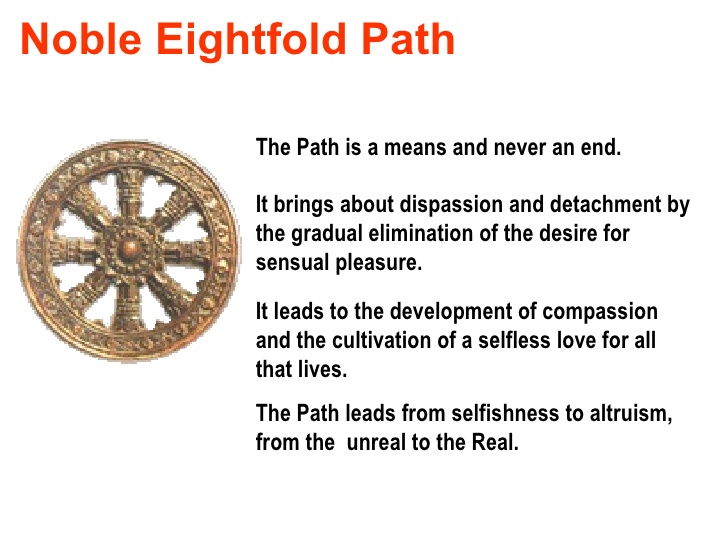
If you want to become enlightened and happy, you must understand that desires are undesirable. The Noble Eightfold Path (八正道) is not the path to enlightenment. It is the supplementary path to guide you on your journey to achieve the state of no-desire (无欲), so that you don’t stray away from the right path. There are no right or wrong in the details of the journey, but there is a right destination. You need to have the desire to reach the destination, but you will not need the desire anymore when you reach the destination. The Noble Eightfold Path was proposed by Shakyamuni Buddha to debunk the practice of Asceticism (hardship and self-torture) and Hedonism (maximization of personal pleasures and consumerism, a basis of Capitalism).


“Right View” (正见): distinguishing right and wrong is an easy task, especially when you follow the standards and rules of others. It is much more difficult to see and understand things as they really are, not as you wish them to be. Life is full of suffering; wishing it otherwise will not change the reality. Intelligent individuals do not need to polarize the world and then choose a side to stand on (无相). They accept (and not just tolerate) the diversity; they don’t have the wish or desire to see only “good” things but not the “bad” things, therefore their feelings not adversely affected by the reality; they have no like and no hate. They have no suffering because they have no desire to see a different reality other than the reality of the Four Noble Truths (四圣谛). Some scholars want to know every detail about everything, but they lose sight of the Four Noble Truths; in the end, they could not extinguish the fires of greed, hatred, and delusion in their heart. The land area of 1 square-foot is all you need to stand on; anything beyond that seems useless but is actually essential to support the land you stand on, without which the 1-square-foot land will collapse and you will not feel secure. Being rich or poor (in terms of money, knowledge, compassion, or other aspects) are both not-wrong and not-right; the world need both of them. It’s OK to be rich or to be poor. It can be a personal choice, although some people choose to feel sad because of inability to become rich or to escape poverty. Some people are even more foolish to hate the rich and feel sad for the poor, instead of saving themselves from being burnt by the fires of greed, hatred, and delusion.


“Right Thinking” (正思维): Until you finally achieve enlightenment and the state of no-desire, you need to keep thinking. Not thinking (执于空) will definitely make you stupid, and that is detrimental to your happiness. In fact, intelligence is essential to sustain the state of no-desire, so that you are not easily swayed and lured towards the Dark Side. Following the standards and rules of others (执于法) is a symptom of not thinking, although most people still think they are thinking. No-desire is the greatest selfishness (because it maximizes your self-interest of being happy), but the world see it as selflessness. By having no-desire, everything you do seems to be not for personal pleasure, but to love others; nobody knows you are actually having fun doing all those things spontaneously, without fakery or artificial conditioning of the mind due to prior mis-education (真人无伪). By having no desire, the threshold level to attain happiness is very low. Every little victory can make you happy. You don’t have to do too much and yet you will be happy every single day. Hardship and self-torture will make you unhappy; while consumerism is like opium which is addictive and will only give you temporary euphoric effects but return to feeling unhappy when the drug wears off. Thinking about anything that will cost you your peace is too expensive. Instead, you should think about how to achieve enlightenment. The Buddha said: “my teaching is not a dogma or a doctrine, but no doubt some people will take it as such. I must state clearly that my teaching is a method to experience reality and not reality itself, just as a finger pointing at the moon is not the moon itself. A thinking person makes use of the finger to see the moon. A person who only looks at the finger and mistakes it for the moon will never see the real moon.”


“Right Speech” (正语): Having no-desire doesn’t mean you don’t even have the desire to speak. A happy person is usually talkative because of the affection. But you must talk to the people who want to listen; therefore, you will naturally have free-of-charge fun talking about events and ideas. You will not become angry; therefore, you will naturally not utter vicious words of hatred, violence, slander, abuse, and lies.


“Right Action” (正业): Having no-desire doesn’t mean you don’t even have the desire to do anything. Not doing anything will cause detrimental effects to your mental and physical health, which will make you unhappy. It is a symptom of stupidity. However, you don’t need to kill or steal for the sake of materialistic pleasure. You don’t have to sell your soul to become rich. Your heart is in your hand; you don’t have to rely on someone or something to make you happy; lest you will have attachment and become un-free. You don’t have to beg for food or donation; you can work it out using your intelligence to self-sustain. By the way, there is nothing wrong about accepting alms without begging. Refrain from doing negative actions that are not helpful (akusala karma) to your progress in attaining enlightenment; on top of that, do positive actions (kusala karma) to accelerate your progress. You have a license to kill (ants, mosquitoes, bugs, etc.) but you should choose not to kill or steal because these are akusala karma. Sin is not a concept of Buddhism; butchers are not criminalized. You should instead try to save all living and non-living things, and give rather than take whenever possible because these are kusala karma, for your own good.


“Right Livelihood” (正命): Having no-desire doesn’t mean you don’t even have the desire to live. On the contrary, you want to live and maximize your happiness. You live as well as you can; eat well, drink well, sleep well, and exercise well (especially with Shaolin Kung Fu). If you are not happy, you have no life although you can still walk. If you are not happy now, you must learn to be happy; otherwise, there is no guarantee that you will ever be happy in the future. There is no path to happiness; happiness is the path. You must stay on the happiness path, and you will continue to be happy into the future. Some people become a monk because they are unhappy with reality. They are probably going to the wrong place to look for happiness, if they are just trying to run away from reality. Happiness is in here and now; you don’t have to look any further. Wanting to live is actually being not afraid to live in this dangerous world (where there are bugs everywhere ranging from the size of a molecule to the size of a human). Wanting to live is being brave to face the reality and future challenges. Kamikaze or Japanese suicide pilots were actually cowards who couldn’t face the defeat of their Empire during WWII and committed the final ditch of craziness. You must also be not afraid to die; otherwise, the fear of death will rob you of your happiness. Death is like walking from one room into another room through a door; there is nothing to be afraid of. And don’t forget to extinguish the candle (of greed, hatred, and delusion) or turn off the light and move on. Being afraid of death will not change the reality. You can become a monk if you want a career of teaching people how to be happy by “swimming to the shore at the opposite side of the bitter sea” (彼岸). It isn’t easy; but the good news is you will not need any more energy to stay afloat when you reach the destination. Some people consume all kinds of foods/drinks/drugs (which they know are harmful to their health) to get the temporary euphoric effects. They are either afraid to live or ignorantly think that they will never get ill or die. On the other hand, some people are afraid to die so much so that they avoid at all costs anything that is rumored as unhealthy. The fact is, there is no unhealthy food; only unhealthy eater.


“Right Efforts” (正精进): Having no-desire doesn’t mean you don’t even have the desire to learn. Not learning will definitely make you stupid, and that is detrimental to your happiness. In fact, knowledge is essential to attain intelligent and sustain the state of no-desire, so that you are not easily swayed and lured towards the Dark Side. You may be intelligent already, but you must still continue to learn from others (破我执). The force of the Dark Side is getting stronger every day. Master Yoda burns the sacred tree at the first temple and incinerates the Jedi Order’s remaining sacred text to make Luke Skywalker even more disillusioned with the Jedi Order. Intelligence is not in the sacred text; it can only be created in your brain. Don’t learn to become clever devil but learn the intelligence to have no worry (绝学无忧); learn to not rely on sacred text (破法执); don’t let your brain remains empty with no knowledge (破空执). The sacred text of the Sage can be misused to benefit the Dark Side. The disciples of the Sage may be recruited by the Dark Side too. Therefore, if the Sage doesn’t die, the evil Empire will not vanish (圣人不死,大盗不止). The people must learn to become intelligent, take their fates into their own hands, and stop worshiping for a “noble” Chancellor or Emperor Palpatine to save the Universe; The First Order is the evil which will create order without spirit (没有生命的有次序). It is better to have disorder with spirit (没有次序的有生命). Clever devils will put their efforts to become cleverer at deceiving people, and also their leaders. Clever Emperor of clever subordinates will feel insecure. Only stupid subordinates will be loyal to the Emperor.


Right Intent (正念): Knowing the benefit of having no-desire is not as good as living with no-desire; living with no-desire is not as good as feeling happy to have no-desire (知之者不如好之者,好之者不如乐之者). If you don’t have a strong intent or persistence to swim to the shore of happiness, you will either stop half-way or never start the journey. You will never reach the destination if you move one step forward and one step back. You will be easily swayed and lured towards the Dark Side; either to the path of self-torture or the path of consumerism. You will remain afloat in the bitter sea. When high intelligent Individuals hear of Dao, they see the subtleness of it and therefore practice it diligently. When middle intelligent individuals hear of Dao, they don’t fully understand it and therefore have some doubts about it. When low intelligent individuals hear of Dao, they laugh because their self-righteous and subjective biases toward an ideology/religion make their minds corrupted with misconceptions and therefore not able to objectively see the truth. Common truth is ordinary; the ultimate truth is uncommon, therefore not easily understood. If common people do not laugh at Dao, that means it is not extraordinary and has nothing subtle (上士闻道,勤而行之;中士闻道,若存若亡;下士闻道,大笑之。不笑不足以为道).


“Right Calmness” (正定): You should have a calm demeanor, peace of mind, and not easily swayed into emotional states when faced with points of view that run counter to your belief or understanding. You should recognize that there are different ways of looking at different things depending on the context and perspectives. If your heart is calm, you will not participate in the debate on whether the wind or the flag is restless. If you have no fear, obligation, and guilt (F.O.G.), you will be able to remain calm even if the mountain collapses in front of you (泰山崩于前而色不变,麋鹿兴于左而目不瞬,骤然临之而不惊,无故加之而不怒). By having no-desire, there is nothing you cannot let go, including your body, you will have no F.O.G. Living another day is a bonus, and a cause for celebration. If you have done everything to save yourself (正命) but yet you have to leave this world, be brave and adventurous to experience the next world. Don’t mourn the past (无住), and don’t worry about the future (无念), but concentrate on the present moment (定). The idea about the cycle of death and rebirth, or reincarnation, was the belief of Jainism which existed long before the birth of Shakyamuni Buddha. In fact, he was a Jainist before becoming the Buddha. He was an Atheist; he had a lack of belief in gods but wasn’t disbelieving in gods. He had a lack of belief in reincarnation but wasn’t disbelieving in reincarnation. Emphasizing living in the present moment precisely tell us not to worry about the future and afterlife. Whether or not there is reincarnation, or existence of Heaven and Hell, is of secondary importance. The most important thing is to learn and experience the Four Noble Truth, leading to the cessation of all suffering, and abandonment of all attachment. We don’t have to know everything. We don’t have to feel anxious for not knowing what will happen after we die. We should instead apply the knowledge of not knowing and face reality as it is. Ignorant is not necessarily a bad thing. It is definitely better than pretending we know the afterlife.


You must make having no desire your lifelong endeavor. Having no desire will bring you the greatest happiness. You are already standing on an undefeatable ground (立于不败之地) when nothing can make you unhappy; no one has the privilege to control your heart and decide the feeling which you are allowed to have. Having no desire is the greatest desire; selflessness is the greatest selfishness. “Taste the tasteless and stay serene to have a clear view of your ambition. Stay comfortable with being unknown and quiescent to reach a great distance in the future.” (淡泊以明志,宁静以致远。) A person with a lot of desire can never do great good because he uses a lot of time and energy for self-serving purposes (i.e. laughably small selfishness compared to the greatest selfishness). An impatient person who is restless will make a lot of mistakes and never go very far; even if he truly desires to do great good for the people. Hope is never a good strategy; good intention is never a guarantee of good outcome. We should intent to have no greedy ambition (but pursue small targets one-by-one instead), do nothing to chase for success (wishing to have no problem to solve instead), and enjoy the tasteless life (because ordinary life is better than given the opportunity to achieve extraordinary success which comes from the suffering of yourself and other people) (为无为 事无事 味无味). Keep learning and be prepared to face challenges anyway; opportunity is reserved for people who are prepared to grab it.


Devadatta wanted to kill the Buddha and takeover his leadership role. He fed large amount of liquor to Nalagiri, the most dangerous elephant in the royal herd of elephants, until it became dangerously drunk. Then the drunken elephant was beaten to make it extremely angry and violent. Finally, the angry, violent, drunk elephant was directed to the street where the Buddha was coming for alms. Nalagiri smashed everything that was on its way. People were terrified and screamed together in one voice. Nalagiri was dashing violently towards the Buddha. All the disciples who were with Buddha was horrified at this terrible sight and scrambled to flee for safety. Only Disciple Ananda stood firmly beside the Buddha. At that time, Buddha himself remained totally at ease and composed. He stood where he was and radiated his loving-kindness towards the elephant. Buddha’s love and compassion were so strong and powerful that the elephant could feel it. Just a few steps before it was about to charge into the Buddha, it stopped in its path and calmed down. It then trotted towards Buddha and respectfully bowed its head. Buddha stroked the elephant’s trunk and comforted it with soft and kind words. The elephant was totally tamed.


Love can appease any hatred only if your power of love is great enough. You can never have enough power of love if you do not abandon all desire and all attachment. Buddha would have been killed by Devadatta and the elephant otherwise. However, his power of love was not enough to overrule Devadatta’s love of power. His power of love could not appease the hatred against him; he could not make everybody loves him. Gandhi’s misjudged of his own power of love led to his assassination by his followers.


THE WORLD IS BEST WITHOUT HERO

Table of Content

It is best to live in a peaceful time when there is no need for Superhero. When people start to cry for Superheroes, and some individuals try to become the Superheroes whom the people desire, it means the world is not peaceful.

A young man went to meet a master at the mountain. He wished to learn the skill to kill a dragon. He spent all his money and three long years to learn the skill from his master. After he graduated and came down from the mountain, he traveled to every corner of the world. Unfortunately, he never found a dragon to kill. Some individuals learn to become Superheroes at the universities. Unfortunately, the skill they acquired may not be useful, or the world has no need for the special skill. You should not desire to learn for the sake of becoming a Superhero. Instead, learn everything that you are interested, for the fun of it. These may become handy as the need arises. You are fortunate if there is no dragon for you to kill.

The king of Zhao State loved sword-fighting skill. Many swordsmen were attracted to Zhao State, and the palace had more than three thousand swordsmen. The king watched the swordsmen fight day and night. In three years, many swordsmen had died but it didn’t lessen the king’s love for sword-fighting skill. The neighboring states were starting to take notice of the lack of governance in the Zhao State, and planned to use the opportunity to conquer it. The prince was worried. He wished to find someone who can stop the king’s obsession. A minister suggested Zhuang Zi.

When Zhuang Zi arrived at the palace, he said to the prince: “I was told that you are worried about the king’s obsession for sword-fighting skill. Let me try to see what I can do.” The prince said: “That would be excellent. However, presently the king only wishes to meet swordsmen and no one else. In his perception, swordsmen must have disorganized hair and rough-spoken manner. Their helmets press on their eyebrows and their staring eyes look like those of a dead fish, when they are ready to fight. You look like a courteous gentleman. The king will not like you.” Zhuang Zi replied: “Then, give me a swordsman’s armor.”

The king was quite happy to see the rough-spoken Zhuang Zi introduced by the prince. The king said: “Your sword-fighting skill must be very good. Otherwise, the prince would not personally introduce you to me.” Zhuang Zi said: “My sword can reach a thousand miles and no one will be able to stop it. If someone tries to stop me, I can kill him within the distance of ten steps.” The king was very excited and said: “You must be the strongest swordsman in the world! Please have a rest for seven days. I must select the best swordsmen to compete with you.” In the selection process, more than sixty swordsmen were killed in the fights. Finally, the best five were selected.

On the eighth day, the king asked Zhuang Zi to come for a competition. The king asked: “What length of sword do you prefer to use?” Zhuang Zi replied: “I have three types of sword. Please choose one for me and I will use it in the competition.” The king asked: “What are the three swords?” Zhuang Zi said: “I have the Sword of the Emperor, the Swords of the King, and the Sword of the Commoner. The Sword of the Emperor uses the Earth terrain and fortified walls as the tip of the sword; the various countries in the world as the sword edge; the surrounding small states as the sword cover. When this sword is pulled out from the cover, it can split the cloud in the sky and break the land into pieces. Everyone in the world will surrender without a fight.” “The Sword of the King uses clever and courageous people as the tip of the sword; honest and righteous personnel as the sword edge; intelligent individuals as the sword handle. When this sword is used, the thunderous sound will cause the various countries to surrender.” “The Sword of the Commoner is commonly used by swordsmen with disorganized hair and rough-spoken manner. Their helmets press on their eyebrows and their staring eyes look like those of a dead fish, when they are ready to fight. When this sword is used, it can sever the head or cut into the heart of enemy, like cock fighting. When they lose their lives, they will not be able to contribute anything else to the state. Your Highness is very fond of the Sword of the Commoner. I think it is a pity.” The king was speechless. He finally realized his foolishness. He stepped down from his throne and held the hand of Zhuang Zi, and he announced: “Today’s sword-fighting competition is over. You may all leave the palace.” The king prepared a royal dinner for Zhuang Zi. At the dinner table, the king was still in a state of edgy and walked around the table three times. Zhuang Zi said: “Please relax and sit down, Your Highness. About the sword-fighting skill, I have said all I wanted to say. I will now excuse myself and return home.” From then onwards, the king never talked about sword-fighting or met the swordsmen again. The swordsmen were angry and they all killed themselves.

Desires for wealth, colorful life, colorful objects, fame, luxurious foods, leisure, and power are like sharpen swords. These can cause harm to yourself and others. The “swordsmen”, aka people who have a lot of desire, often have a funny look: staring eyes and angry faces. They compete with one another and lose their “lives”; i.e. feeling unhappy every day, fearing about the future, burdening themselves with obligations, and not forgiving themselves for failures. They “kill” themselves for not getting the kind of success that they desired. Are they courageous or stupid? Many leaders are fond of the Sword of the Commoner (personal desire). They use it every day for competitions after competitions. Some of them win while the others lose out. Some leaders have the Sword of the King (organizational desire with good human resources) because of the scale of their organizations. They use the sword to force other people to surrender. A great leader will use the Sword of the Emperor, cooperating with other leaders, and use the appropriate tools to work for common goods of the people. No coercion is needed. No superhero is needed when there are no super-monsters (such as Adolf Hitler and Hideki Tojo) to kill; crimes caused by thugs and terrorists can be appropriately controlled by the policemen.

Table-of-Content

1. HOW TO RAISE A RESILIENT KID: I AM NOT RIGHT BUT THAT’S OK
2. Right and Wrong 是和非
3. Balance between Yin and Yang: Learn from the Nature
4. Each of us has a role to play, and that role is to live happily
5. There are “good” and “bad” in everything
6. Name and Nameless 有和无
7. Useful and Useless
8. HAPPY AND UNHAPPY
9. EVERYTHING IS USEFUL, IN ONE WAY OR ANOTHER
10. TO JUDGE OR NOT TO JUDGE?
11. DEFEND YOURSELF AND YOUR LOVE ONES
12. Honors and Disgraces 荣和辱
13. INTELLIGENT AND CLEVER
14. SELFLESSNESS IS THE GREATEST SELFISHNESS
15. COMPASSION AND RIGHTEOUSNESS
16. BRAINWASHED
17. BULLIES ARE CREATED BY BULLIES
18. ALL MANMADE DISTINCTIONS ARE FALSE
19. FEAR AND ANGER
20. THE GREATEST SHAME IS SHAMELESS
21. PEACE IS NOT THE ABSENCE OF WAR
22. TAKE REFUGE IN YOURSELF
23. FRIENDS AND FOES 离和合
24. WHAT FRIENDS ARE FOR
25. HOW TO CHOOSE A FRIEND
26. BEST FRIEND
27. YOU ONLY LOSE WHAT YOU CLING TO
28. HOW TO BE A GOOD FRIEND
29. PERFECTION OF WISDOM
30. COMPANIONSHIP
31. SUCCESS AND FAILURE 成和败
32. HOPE IS NEVER A GOOD STRATEGY
33. NO ONE SAVES US BUT OURSELVES
34. PERMANENT PLATEAU OF PEACE
35. BE FLEXIBLE
36. DON’T COMPETE
37. THE WORLD IS BEST WITHOUT HERO
38. THE NOBLE EIGHTFOLD PATH
39. BE HAPPY TO BE WHO YOU ARE
40. BE YOUR OWN LEADER FIRST
41. STAY CRAZY AND STAY FOOLISH
42. FREE YOURSELF FROM SUFFERING
43. STAY AWAY FROM DANGER
44. LIFE AND DEATH 生和死
45. THE GREATEST BENEVOLENCE NEEDS NO GIVING
46. EMPATHY AND COMPASSION
47. THE PATH IS SIMPLE IF YOU DON’T MAKE IT DIFFICULT
48. REAL JEDI
49. Jedi in the Chinese history
50. Perfect Wisdom